Showing posts with label Martin Luther King. Show all posts

Friday, March 13, 2009

Black History: The March On Washington

Crossposted from Left Toon Lane, Bilerico Project & My Left Wing


click to enlarge
Birth Of A Notion Disclaimer

From Wikipedia:


The March on Washington for Jobs and Freedom was a large political rally that took place in Washington, D.C. on August 28, 1963. Martin Luther King, Jr. delivered his historic "I Have a Dream" speech advocating racial harmony at the Lincoln Memorial during the march.

The march was organized by a group of civil rights, labor, and religious organizations, under the theme "jobs, justice, and peace." Estimates of the number of participants varied from 200,000 (police) to over 300,000 (leaders of the march). About 80% of the marchers were African American and 20% white and other ethnic groups.

The march is widely credited as helping lead to the Civil Rights Act (1964) and the National Voting Rights Act (1965).

The march was initiated by A. Philip Randolph (international president of the Brotherhood of Sleeping Car Porters, president of the Negro American Labor Council, and vice president of the AFL-CIO), who had planned a similar march in 1941. The threat of the earlier march had convinced President Roosevelt to establish the Committee on Fair Employment Practice and bar discriminatory hiring in the defense industry.

The 1963 march was organized by Randolph, James Farmer (president of the Congress of Racial Equality), John Lewis (president of the Student Nonviolent Coordinating Committee), Martin Luther King, Jr. (president of the Southern Christian Leadership Conference), Roy Wilkins (president of the NAACP), and Whitney Young (president of the National Urban League). Bayard Rustin, a civil rights veteran and organizer of the 1947 Journey of Reconciliation, the first of the Freedom Rides to test the Supreme Court ruling that banned racial discrimination in interstate travel, administered the details of the march.

The march was not universally supported among African-Americans. Some civil rights activists were concerned that it might turn violent, which could undermine pending legislation and damage the international image of the movement and they were self conscious. The march was condemned by Malcolm X, spokesperson for the Nation of Islam, who termed it the "farce on Washington".

March organizers themselves disagreed over the purpose of the march. The NAACP and Urban League saw it as a gesture of support for a civil rights bill that had been introduced by the Kennedy Administration. Randolph, King, and the SCLC saw it as a way of raising both civil rights and economic issues to national attention beyond the Kennedy bill. SNCC and CORE saw it as a way of challenging and condemning the Kennedy administration's inaction and lack of support for civil rights for African-Americans.

The speakers included all six civil-rights leaders of the so called, "Big Six (civil rights)"; Catholic, Protestant, and Jewish religious leaders; and labor leader Walter Reuther. The one female speaker was Josephine Baker. James Farmer, who was imprisoned in Louisiana at the time, had his speech read by Floyd McKissick

Media attention gave the march national exposure, carrying the organizers' speeches and offering their own commentary. In his section The March on Washington and Television News, William Thomas notes: "Over five hundred cameramen, technicians, and correspondents from the major networks were set to cover the event. More cameras would be set up than had filmed the last Presidential inauguration. One camera was positioned high in the Washington Monument, to give dramatic vistas of the marchers".

On August 28, more than 2,000 buses, 21 special trains, 10 chartered airliners, and uncounted cars converged on Washington. The regularly scheduled planes, trains, and buses were also filled to capacity.

The march failed to start on time, because its leaders were meeting with members of Congress. To the leaders' surprise, the assembled group began to march from the Washington Monument to the Lincoln Memorial without them.

Representatives from each of the sponsoring organizations addressed the crowd from the podium. Floyd McKissick read James Farmer's speech because Farmer had been arrested during a protest in Louisiana; Farmer had written that the protests would not stop "until the dogs stop biting us in the South and rats stop biting us in the North."

Musician Bob Dylan performed several songs, including "Only a Pawn in Their Game," about the culturally-fed racial hatred amongst Southern whites that led to the assassination of Medgar Evers; and "When the Ship Comes In," during which he was joined by fellow folk singer Joan Baez.

King gave his famous I Have a Dream speech, which was carried live by TV stations.

Although one of the officially stated purposes of the march was to support the civil rights bill introduced by the Kennedy Administration, several of the speakers criticized the proposed law as insufficient.
John Lewis of SNCC was the youngest speaker at the event. His speech—which a number of SNCC activists had helped write—took the Administration to task for how little it had done to protect southern blacks and civil rights workers under attack in the Deep South. While he toned down his comments under pressure from others in the movement, his words still stung:


We march today for jobs and freedom, but we have nothing to be proud of, for hundreds and thousands of our brothers are not here—for they have no money for their transportation, for they are receiving starvation wages…or no wages at all. ...

We come here today with a great sense of misgiving. It is true that we support the administration's Civil Rights Bill. We support it with great reservation, however. ... Unless title three is put in this bill, there's nothing to protect the young children and old women who must face police dogs and fire hoses in the South while they engage in peaceful demonstration. In its present form this bill will not protect the citizens of Danville, Virginia, who must live in constant fear of a police state. ... As it stands now, the voting section of this bill will not help the thousands of people who want to vote. ... We must have legislation that will protect the Mississippi sharecroppers, who have been forced to leave their homes because they dared to exercise their right to register to vote.

We need a bill that will provide for the homeless and starving people of this nation. We need a bill that will ensure the equality of a maid who earns five dollars a week in the home of a family whose total income is 100,000 dollars a year. We must have a good FEPC bill.

My friends let us not forget that we are involved in a serious social revolution. By and large, politicians who build their career on immoral compromise and allow themselves an open forum of political, economic and social exploitation dominate American politics. ... what political leader can stand up and say, "My party is a party of principles"? For the party of Kennedy is also the party of Eastland. The party of Javits is also the party of Goldwater. Where is our party? Where is the political party that will make it unnecessary to march on Washington? Where is the political party that will make it unnecessary to march in the streets of Birmingham? Where is the political party that will protect the citizens of Albany, Georgia? ... We must say wake up America, wake up its now 2:00 in the afternoon! For we cannot stop, and we will not and cannot be patient.


Cut from his original speech at the insistence of more conservative and pro-Kennedy leaders were phrases such as:


In good conscience, we cannot support wholeheartedly the administration's civil rights bill, for it is too little and too late.

I want to know, which side is the federal government on?

The revolution is a serious one. Mr. Kennedy is trying to take the revolution out of the streets and put it into the courts. Listen, Mr. Kennedy. Listen, Mr. Congressman. Listen, fellow citizens. The black masses are on the march for jobs and freedom, and we must say to the politicians that there won't be a "cooling-off" period.

We will march through the South, through the heart of Dixie, the way Sherman did. We shall pursue our own scorched earth policy and burn Jim Crow to the ground—nonviolently...


Many activists from SNCC, CORE, and even SCLC were angry at what they considered censorship of his speech.


BIRTH OF A NOTION WALLPAPER is now available for your computer. Click here.

Sunday, January 18, 2009

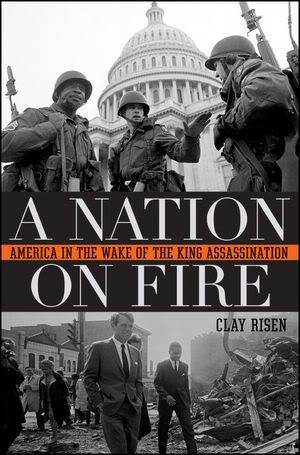
When America Burned After the King Assassination: An Interview With Author Clay Risen

The topic below was originally posted on my blog, the Intrepid Liberal Journal.

Tomorrow, America honors the birthday of heroic civil rights activist Martin Luther King. Americans revere King across the political and ethnic spectrum for his wisdom, idealism, courage and practice of non-violent civil disobedience against the forces of racial oppression. Thanks in large part to the trailblazing efforts of King and his followers; America inaugurates its first black president the very next day when Barack Obama takes the oath of office on January 20th. Yet even as Americans celebrate the historical arc from Martin Luther King to Barack Obama, the scars of racial injustice remain woven into our country’s fabric.

Understandably, historians have overlooked the immediate aftermath of King’s assassination in a Memphis, Tennessee hotel on April 4th, 1968. The meaning of King’s life as well as the tragedy his loss represented has received considerable attention from historians and the body politic. Yet the immediate aftermath of King’s death was dwarfed by his iconic life as well as the assassination of Robert Kennedy and the violence that took place during the Democratic National Convention later that year.

Clay Risen, author of A Nation On Fire: America In the Wake of the King Assassination (John Wiley & Sons) argues that what transpired immediately after April 4th impacted America as intensely as King’s death itself. Within hours, there was rioting in Washington D.C. and before the violence subsided, the U.S. Army occupied three major American cities while National Guard units patrolled a dozen more. Overall, there were disturbances in nearly 120 cities. Ultimately, the riots helped facilitate forty years of conservative hegemony as urban America reaped the whirlwind of white resentment and indifference.

Risen specifically chronicles the period covering President Lyndon Johnson’s withdrawal from the 1968 campaign on March 31st, to King’s assassination on April 4th and culminates with Johnson’s signing of the 1968 Civil Rights Act on April 11th. The author relies on dozens of interviews as well as newly declassified documents to provide a dramatic day-by-day, city-by-city narrative of the riots, from the looting in Washington to violence in Chicago, Baltimore and other cities following King's death in Memphis.

Indeed, Risen skillfully takes the reader on a historical tour with larger than life personalities like the militant Stokely Carmichael to white racist vigilantes in Baltimore and political figures such as New York City Mayor John Lindsey, Chicago Mayor Richard Daley, New York Senator Robert Kennedy and Maryland Governor Spiro Agnew. Perhaps the book’s most dramatic anecdote was when a young Deputy Attorney General named Warren Christopher, joined General Ralph Haines, and Public Safety Commissioner Patrick Murphy at a Washington DC gas station pay-phone to recommend to President Johnson that he deploy federal troops in the nation’s capitol.

George Pelecanos, author of The Turnaround and The Night Gardner issued the following praise for Risen’s book:

“Clay Risen’s A Nation on Fire is the long-awaited definitive account of one of the most important, underreported events of the 1960s. As important for its historical aspect as it is for understanding where we are today, it is an exciting, important document, excitingly told.”
Risen, was formerly an editor at The New Republic and is the founding Managing Editor of Democracy: A Journal of Ideas. He has also contributed to Smithsonian, Slate, the Atlantic, and the New York Times Sunday Magazine. Risen agreed to a telephone interview with me in a podcast format about his book as well as the fateful days following King’s death. Our conversation was just over forty-seven minutes. Please refer to the flash media player below.


Either searching for the Intrepid Liberal Journal or Robert Ellman can also access this interview at no cost via the Itunes Store.

Friday, January 11, 2008

I still have a dream and Hillary ain’t in it.

Crossposted from Left Toon Lane, Bilerico Project & My Left Wing


click to enlarge

Many in the blogosphere just simply do not believe someone would say...

I can’t believe we have to vote for Hillary to keep the nigger out of the White House.


But that is the reality of racism in America. Yes, we have made great strides and the younger generation cares less about race than the older generations. But this divide I think is being overlooked from a demographic and message standpoint.

Whether you believe Hillary cried or became teary on the campaign trail, whether you believe it was staged or legitimate, it was a risky campaign move. Remember back in March of 2007 when Hillary crashed Obama's campaign in Selma? It was not looked warmly upon by the Black community in general, she looked like an opportunist. Then during a speech, she adopted a fake accent and tried to recite Rev. James Cleveland's hymn "I do not feel noways tired." When I heard that I half way expected the next thing to come out of her mouth to be "don't trust whitey."

The general population seems to believe Hillary cried to win New Hampshire. If you are Black, you may see it differently - you may see that she cried to beat a Black man.

MLK took a lot of abuse and ultimately died so people like Barack Obama could have equal rights and hold public office. The Black experience in America is paved with real tears, pain, abuse and murder. The younger you are, the less you care about color and that is Obama's key demographic. Hillary's is the older generation and they care a lot more about race than the youth do. But the older Black generation remembers Selma.

They remember the tear gas.

Tuesday, September 11, 2007

Assault of America - Rev. Lennox Yearwood attacked, and hospitalized

Beyond Vietnam: A Time to Break Silence


The ultimate test of a man is not where he stands in moments of comfort and moments of convenience, but where he stands in moments of challenge and moments of controversy.

--Martin Luther King, Jr., 27 January 1965


Beyond IRAQ: A Time to Break Silence


Protesting The War

Meanwhile we in the churches and synagogues have a continuing task while we urge our government to disengage itself from a disgraceful commitment. We must continue to raise our voices if our nation persists in its perverse ways in Vietnam. We must be prepared to match actions with words by seeking out every creative means of protest possible.

Dr. Martin Luther King, Jr., on April 4, 1967


Please read the speech delivered by Dr. Martin Luther King, Jr., on April 4, 1967, at a meeting of Clergy and Laity Concerned at Riverside Church in New York City HERE.

This Madness Must Cease

Somehow this madness must cease. We must stop now. I speak as a child of God and brother to the suffering poor of Vietnam. I speak for those whose land is being laid waste, whose homes are being destroyed, whose culture is being subverted. I speak for the poor of America who are paying the double price of smashed hopes at home and death and corruption in Vietnam. I speak as a citizen of the world, for the world as it stands aghast at the path we have taken. I speak as an American to the leaders of my own nation. The great initiative in this war is ours. The initiative to stop it must be ours.

This is the message of the great Buddhist leaders of Vietnam. Recently one of them wrote these words:

"Each day the war goes on the hatred increases in the heart of the Vietnamese and in the hearts of those of humanitarian instinct. The Americans are forcing even their friends into becoming their enemies. It is curious that the Americans, who calculate so carefully on the possibilities of military victory, do not realize that in the process they are incurring deep psychological and political defeat. The image of America will never again be the image of revolution, freedom and democracy, but the image of violence and militarism."

If we continue, there will be no doubt in my mind and in the mind of the world that we have no honorable intentions in Vietnam. It will become clear that our minimal expectation is to occupy it as an American colony and men will not refrain from thinking that our maximum hope is to goad China into a war so that we may bomb her nuclear installations. If we do not stop our war against the people of Vietnam immediately the world will be left with no other alternative than to see this as some horribly clumsy and deadly game we have decided to play.

The world now demands a maturity of America that we may not be able to achieve. It demands that we admit that we have been wrong from the beginning of our adventure in Vietnam, that we have been detrimental to the life of the Vietnamese people. The situation is one in which we must be ready to turn sharply from our present ways.

In order to atone for our sins and errors in Vietnam, we should take the initiative in bringing a halt to this tragic war. I would like to suggest five concrete things that our government should do immediately to begin the long and difficult process of extricating ourselves from this nightmarish conflict:

  1. End all bombing in North and South Vietnam.
  2. Declare a unilateral cease-fire in the hope that such action will create the atmosphere for negotiation.
  3. Take immediate steps to prevent other battlegrounds in Southeast Asia by curtailing our military buildup in Thailand and our interference in Laos.
  4. Realistically accept the fact that the National Liberation Front has substantial support in South Vietnam and must thereby play a role in any meaningful negotiations and in any future Vietnam government.
  5. Set a date that we will remove all foreign troops from Vietnam in accordance with the 1954 Geneva agreement.

Part of our ongoing commitment might well express itself in an offer to grant asylum to any Vietnamese who fears for his life under a new regime which included the Liberation Front. Then we must make what reparations we can for the damage we have done. We most provide the medical aid that is badly needed, making it available in this country if necessary. More HERE.

Dr. Martin Luther King, Jr., on April 4, 1967