


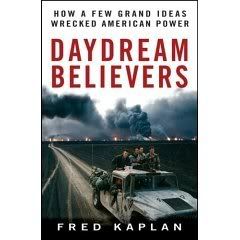
“Nearly all of America’s blunders in war and peace these past few years stem from a single grand misconception: that the world changed after 9/11, when in fact it didn’t.Kaplan also postulates that the Bush Administration as well as most Americans falsely believed we emerged from our Cold War victory stronger. In reality, our geopolitical position was weakened after the Soviet Union’s collapse in 1991 because America’s allies were free to pursue their own interests. In a bipolar Cold War world, America’s allies depended on our protection and remained subservient to our leadership. Once the Cold War ended however, maintaining international coalitions required more compromise and skilled diplomacy because we didn’t enjoy the same leverage. Tragically, the Bush Administration completely misread our geopolitical position and alienated the world at the very moment we needed friends. Even more remarkable when one considers how much of the world was initially sympathetic to America following 9/11. Compounding these misconceptions was a Secretary of Defense in Donald Rumsfeld who simply viewed Iraq as a laboratory to demonstrate how easily America could topple a sovereign government’s regime. As Kaplan notes in his book, once Saddam’s government fell, Rumsfeld lost all interest in the required follow through as Iraq went to hell. Kaplan also provides anecdotes in his book to explain that in George W. Bush’s universe, freedom is humanity’s default state. Hence, all one had to do was use military power to eliminate an obstacle to freedom like Saddam Hussein or hold elections in Palestine and freedom would magically appear. Bush, Cheney and Rumsfeld never considered the hard work of establishing conditions that facilitate a civil society so necessary to freedom as important. Thomas E. Ricks, the author of Fiasco: The American Military Adventure In Iraq, had the following praise for Kaplan’s book: “This is the inside history of our time, told with precision and confidence by an author who knows where the secrets are kept – and also that the most powerful and dangerous weapon in Washington, D.C. is a new idea.”Kaplan who writes the “War Stories” column for Slate was a Pulitzer Prize winning reporter for the Boston Globe while covering the Pentagon and post Soviet Moscow. He’s also the author of the classic book, The Wizards of Armageddon and has written for The Atlantic Monthly, the New York Times, the New Yorker and The Washington Post among other publications. Kaplan agreed to a podcast interview with me over the telephone about his book and national security policy during the Bush years. Our conversation was just over forty minutes and covered the concept known as a “revolution in military affairs,” the fateful decision to disband the Iraqi army and ban members of the Baath Party from serving in high level positions, the Bush Administration’s bizarre path to a diplomatic accommodation with North Korea, the dysfunctional reign of Donald Rumsfeld as Secretary of Defense, the current dynamic with Rumsfeld’s successor Robert Gates and the path future presidents will need to follow for a sensible foreign policy. Please refer to the media player below. This interview can also be accessed for free via the Itunes Store by searching for “Intrepid Liberal Journal.” |
Showing posts with label cheney. Show all posts
Showing posts with label cheney. Show all posts
Monday, February 18, 2008
An Interview With Pulitzer Prize Winning Journalist and Author Fred Kaplan


Monday, May 14, 2007
Fuzzy Baghdad Math
 click to enlarge Can we do the math anymore? Not if the administration and the Iraqi government has it's way. There are moves afoot to ban reporters from bomb attack sites, stop publication of morgue statistics and continue the policy of discluding civilians in the causality numbers. Daily Kos Diarist BarbinMD has an excellent front page story on this very issue. But there is another problem with the body count that I really don't see being address in the mainstream media and that is the so-called surge. Are we really adding troops on the ground or is the real purpose of the surge is simply to replace the dead and the wounded? Yes, the death rate in Iraq is lower than Vietnam, but the number of critically wounded is historically high. So all those dead and wounded soldiers need to be replaced at some point. But do we really know? With the BushCo propaganda machine in full swing against the Democrats, it is damn near impossible to find real data or troop exchanges. So I going on gut instinct here and say we are really just replacing troops lost in combat with just a tinge of new folks for the so-called surge. This is a good time to review my "gut instinct" policy - under the Bush Administration, however bad things appear to be, in reality they are five times worse. Your mileage may vary. |
Saturday, April 14, 2007

Monday, March 19, 2007
Four More Years! A look back at Iraq.
 click to enlarge We have spent four glorious years in Iraq. Four years of lies, deception and greed. Four years of squandered international good will. Four years of violence and turmoil. Four years of torture. Four years of losing civil rights. Four years of civil war. Four years of losing the hearts and minds. Four years of funerals. Feel free to add to the list… |
Monday, March 12, 2007
Cheney’s dietary supplements
 click to enlarge I have always felt when a politician brings up their relationship with God in a campaign, they are usually as far away from morality and their faith as they can possible get. I get that from Cheney and doubly so from Bush (maybe triple). They give great lip service to the Lord Almighty™ but are total failures in showing examples of their faith in their daily lives. I understand the need to keep diplomatic relations with an enemy nation, but Bush has constantly cozied up with some of the most atrocious people on the planet. His personal relationship, as well as his family's, with Middle East dictators has always been troubling. (Don't get me started on the whole Nazi nastiness) And the same goes for Dick Cheney and his Halliburton. So I hear Cheney talk about Christianity and know it is all a lie, so I must also conclude that all his positive, love-fest language about Jews is equally false. Israel doesn't have that much oil production, so why should Cheney give a shit about them? |
Wednesday, March 7, 2007
The border fence is not a solution... unless you are Halliburton.
 click to enlarge The only one who will benefit from a border fence will be the contractor and it will probably be someone attached to Cheney. And by all evidence seen from the war, Katrina and now Walter Reed, everything this man touches turns to shit. But it wouldn't surprise me if Halliburton got the border fence contract. That is how despotism rolls. But beyond that, fences and walls never work and the one planned for our southern border will just as much of a disaster - for humans, the economy and for the environment. The stupid man builds a fence, the smart one fixes the problem that created the need for the fence and Bush does not have that ability since he can't bomb the sweatshops illegal immigrants work in here in the U.S. Those are called contributors. That is Bush's only tool it seems - the bomb. Bomb them into submission, bomb them out of existence, bomb them into the stone-age, we have heard those lines before from the GOP. That is all they know. They are incapable of solving a problem where the solution begins with the human heart. Cheney's has nothing but springs and gears. |
Subscribe to:
Posts (Atom)