


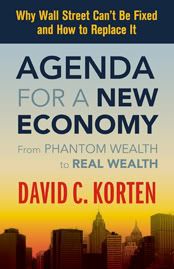
“We face a monumental economic challenge that goes far beyond anything being discussed in the U.S. Congress or the corporate press. The hardships imposed by temporarily frozen credit markets pale in comparison to what lies ahead.Internationally renowned social scientist and historian David Korten wrote those words in the introduction of his new book, Agenda For A New Economy: From Phantom Wealth To Real Wealth, scheduled to be released by Berrett-Kohler Publishers tomorrow. Some of you may have previously read Korten’s 1995 international bestseller, When Corporations Rule the World. Longtime readers/listeners of the Intrepid Liberal Journal may also recall my August 2007 podcast interview with Korten about his book, The Great Turning: From Empire To Earth Community. You can learn more about Korten’s background by clicking here and reading the introductory text to that podcast. Korten’s current book is organized in four parts: Part I, The Case for a New Economy; Part II, The Case for Eliminating Wall Street; Part III, Agenda for a Real Wealth Economy and Part IV, Change the Story, Change the Future. Essentially, Korten divides the economy into “Wall Street” and “Main Street.” The first half of Korten’s book is dedicated to indicting Wall Street for generating “phantom wealth” at the expense of society’s quality of life. In the second half, Korten promotes twelve concepts to empower a “Main Street” economy that facilitates the exchange of tangible goods and services among citizens living within their means. His diagnosis and prescriptions are jarring. Korten postulates that Main Street is far closer to the original vision of Adam Smith while Wall Street capitalism is the antithesis of a free market economy. Reform-minded liberals, who believe we can work within America’s established financial credit markets banking system and stabilize our economy with band-aids and bailouts, will likely be just as opposed to his book as Wall Street apologists. Conservatives will likely dismiss Korten’s solutions because he believes in government regulation to ensure that businesses and citizens behave within agreed upon social norms. As Korten sees it, corporations in a Wall Street economy are given incentives to destroy the planet’s environment and inflate its financial statements by taking a wrecking ball to the middle class. In a true market economy, business entities that inflict harm on the environment and their community’s overall quality of life could not survive. Hence, Korten writes that under a Wall Street economy, corporations, “If it were a real person, it would fit the clinical profile of a sociopath.”Sadly, in American society, sociopathic behavior was rewarded as the proper spoils of capitalism. Hence, one of Korten’s twelve concepts to empower a Main Street economy is to “Reclaim the corporate charter” so that the public has a means of ensuring accountability and social responsibility. The future that Korten envisions is a community ethos in which citizens and businesses have a stake in the health, infrastructure and overall quality of life in their local community as well as the world at large. Vicki Robin, coauthor of Your Money or Your Life and cofounder of Conversation Cafes issued the following praise for Korten’s book: “Once again David Korten has provided us with a clear understanding of why the old economy is driving us and nature to ruin - and a framework for transforming it. Especially in this time of economic meltdown it's crucial for caring people everywhere to get that patching the tires of a vehicle that's going over a cliff is neither sane nor acceptable. The financial crisis is a healing crisis and Korten gives us prescriptions that could actually give us a thriving and just economy that works for people and the planet. I hope every reader feels, as I have, a sense of relief at hearing the truth and a renewed passion for civic engagement, now knowing what direction we need to steer our ship."Korten agreed to a podcast interview with me over the telephone yesterday afternoon about his latest book, why he believes the Wall Street economy is irredeemable and his solutions for the future. Our conversation was approximately forty-two minutes. Please refer to the flash media player below. Either searching for “Intrepid Liberal Journal” or “Robert Ellman” can also access this interview at no cost via the Itunes Store. |
Showing posts with label David Korten. Show all posts
Showing posts with label David Korten. Show all posts
Monday, February 2, 2009
America, It's Time To Say Goodbye To Wall Street: An Interview With Author David Korten


Sunday, August 12, 2007
Replacing the Empire Culture: A Podcast Interview With Author David Korten
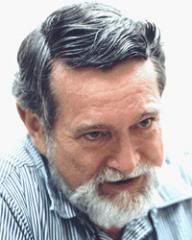
“There is a culture war in America, but it is not between liberals and conservatives, who in fact share a great many core values – including a commitment to children, family, community, personal responsibility and democracy. It is between the lower and higher orders of our human nature. It is between an imperial politics of individual greed and power and a democratic politics based on principle and the common good. It is between Power Seekers at the extreme political fringes who remain imprisoned in an Imperial Consciousness and the realists of the political mainstream who truly want to solve the problems that beset us all.”David Korten wrote those provocative words in his book, The Great Turning: From Empire to Earth Community published last year by Berrett-Kohler. Korten worked for more than thirty-five years in preeminent business, academic, and international development institutions. He eventually turned away from the establishment and instead worked with public interest citizen action groups. He is the co-founder and board chair of the Positive Futures Network and Yes! A Journal of Positive Futures, an associate of the International Forum on Globalization and a member of the Club of Rome. He serves on the boards of the Business Alliance for Local Living Economics and the Bainbridge Graduate Institute. In his early career, Korten set up business schools in low-income countries starting with Ethiopia, hoping to help establish a new class of professional business entrepreneurs would be the key to ending global poverty. He also completed his military service stateside during the Vietnam War as a captain in the U.S. Air Force, with duty at the Special Air Warfare School, Air Force headquarters command, the Office of the Secretary of Defense and the Advanced Research Projects Agency. Following his service in the military, Korten was a faculty member of the Harvard University Graduate School of Business where he taught in Harvard’s middle management, M.B.A. and doctoral programs. Korten also served as Harvard’s adviser to the Central American Management Institute in Nicaragua and later joined the staff of the Harvard Institute for International Development, where he headed a Ford Foundation funded project to strengthen the organization and management of national family planning programs. When Korten left academia in 1970 he moved to Southeast Asia where he lived for almost fifteen years, serving as a Ford Foundation project specialist and later as Asia regional advisor on development management in the U.S. Agency for International Development (USAID). His work there earned Korten international recognition for helping to engineer the development of intervention strategies for transforming public bureaucracies into responsive support systems dedicated to strengthening community control and management of land, water and forestry resources. Korten ultimately broke with the international aid system when he became convinced they were actually increasing poverty and environmental destruction and impervious to change. During the last five years of Korten’s work in Asia he coordinated with leaders of Asian nongovernmental organizations on identifying the root causes of development failure in the region and building the capacity of civil society organizations to better facilitate positive global level change. Korten’s life experience abroad convinced him that the United States was actively promoting both at home and abroad – the very policies responsible for, inequality, environmental devastation and social disintegration. At that point a friend advised Korten he would best serve the cause of ending global poverty by returning to the United States and educating his fellow Americans about the destructive role of corporate imperialism. Hence, Korten returned to the United States in 1992 to share with his fellow Americans the lessons he had learned abroad. Ironically, Korten’s original motivation for international travel as a college senior in 1959 was to persuade the world’s poor to reject revolution in favor of America’s political and economic system. Instead, as he writes, Korten found himself learning far more from the people he hoped to teach: “The subsequent experience of working for some thirty years as a member of the international development establishment profoundly changed my worldview. I had gone abroad to teach. Far more consequential than what I taught was what I learned – about myself, my country, and the human tragedy of unrealized possibility. Ultimately, I realized I must return to the land of my birth to share with my people the lessons of my encounter with the world.”In 1995 Korten published an international bestseller, When Corporations Rule the World and followed that up with The Post Corporate World: Life After Capitalism several years later. Korten agreed to a podcast interview with me about his current book, life experience and worldview. Please refer to the media player below. The interview is approximately fifty-six minutes. This interview can also be accessed at no cost via the Itunes store by searching for Intrepid Liberal Journal. |
Subscribe to:
Posts (Atom)