


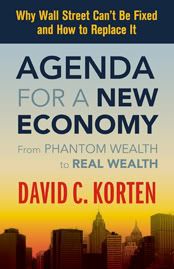
“We face a monumental economic challenge that goes far beyond anything being discussed in the U.S. Congress or the corporate press. The hardships imposed by temporarily frozen credit markets pale in comparison to what lies ahead.Internationally renowned social scientist and historian David Korten wrote those words in the introduction of his new book, Agenda For A New Economy: From Phantom Wealth To Real Wealth, scheduled to be released by Berrett-Kohler Publishers tomorrow. Some of you may have previously read Korten’s 1995 international bestseller, When Corporations Rule the World. Longtime readers/listeners of the Intrepid Liberal Journal may also recall my August 2007 podcast interview with Korten about his book, The Great Turning: From Empire To Earth Community. You can learn more about Korten’s background by clicking here and reading the introductory text to that podcast. Korten’s current book is organized in four parts: Part I, The Case for a New Economy; Part II, The Case for Eliminating Wall Street; Part III, Agenda for a Real Wealth Economy and Part IV, Change the Story, Change the Future. Essentially, Korten divides the economy into “Wall Street” and “Main Street.” The first half of Korten’s book is dedicated to indicting Wall Street for generating “phantom wealth” at the expense of society’s quality of life. In the second half, Korten promotes twelve concepts to empower a “Main Street” economy that facilitates the exchange of tangible goods and services among citizens living within their means. His diagnosis and prescriptions are jarring. Korten postulates that Main Street is far closer to the original vision of Adam Smith while Wall Street capitalism is the antithesis of a free market economy. Reform-minded liberals, who believe we can work within America’s established financial credit markets banking system and stabilize our economy with band-aids and bailouts, will likely be just as opposed to his book as Wall Street apologists. Conservatives will likely dismiss Korten’s solutions because he believes in government regulation to ensure that businesses and citizens behave within agreed upon social norms. As Korten sees it, corporations in a Wall Street economy are given incentives to destroy the planet’s environment and inflate its financial statements by taking a wrecking ball to the middle class. In a true market economy, business entities that inflict harm on the environment and their community’s overall quality of life could not survive. Hence, Korten writes that under a Wall Street economy, corporations, “If it were a real person, it would fit the clinical profile of a sociopath.”Sadly, in American society, sociopathic behavior was rewarded as the proper spoils of capitalism. Hence, one of Korten’s twelve concepts to empower a Main Street economy is to “Reclaim the corporate charter” so that the public has a means of ensuring accountability and social responsibility. The future that Korten envisions is a community ethos in which citizens and businesses have a stake in the health, infrastructure and overall quality of life in their local community as well as the world at large. Vicki Robin, coauthor of Your Money or Your Life and cofounder of Conversation Cafes issued the following praise for Korten’s book: “Once again David Korten has provided us with a clear understanding of why the old economy is driving us and nature to ruin - and a framework for transforming it. Especially in this time of economic meltdown it's crucial for caring people everywhere to get that patching the tires of a vehicle that's going over a cliff is neither sane nor acceptable. The financial crisis is a healing crisis and Korten gives us prescriptions that could actually give us a thriving and just economy that works for people and the planet. I hope every reader feels, as I have, a sense of relief at hearing the truth and a renewed passion for civic engagement, now knowing what direction we need to steer our ship."Korten agreed to a podcast interview with me over the telephone yesterday afternoon about his latest book, why he believes the Wall Street economy is irredeemable and his solutions for the future. Our conversation was approximately forty-two minutes. Please refer to the flash media player below. Either searching for “Intrepid Liberal Journal” or “Robert Ellman” can also access this interview at no cost via the Itunes Store. |
Showing posts with label wall street. Show all posts
Showing posts with label wall street. Show all posts
Monday, February 2, 2009
America, It's Time To Say Goodbye To Wall Street: An Interview With Author David Korten


Wednesday, September 24, 2008
I'm From Wall St. And I Am Here To Help You
 click to enlarge I am not one of those people who want to shrink government to a size where it could be drowned in a bathtub. That said, I have had more than enough "assistance" from the government on FISA, the Patriot Act, the Schiavo debacle and on and on. I do not need any assistance from the government to bail-out billionaires. Cry me a river. One thing I have not seen a lot of chatter about is how we are going to pay the national debt, plus all the non-discretionary line items like Social Security, and Medicare. Once the Treasury is empty, Americans have nothing but personal debt left and there is nothing left to the value of America, what is left to sell, leverage or exploit to pay off the Reaganomics inspired spending? Public land. A few years ago, I read an economic report on the real estate value of national parks and forests in California. For the life of me, I cannot find that report on the web. The base idea (a GOP idea I bet) was to sell off select national parks and monuments like the Presidio and Yosemite to land developers. The report took the value of the land near these parks and calculated the real estate value of these areas and concluded that the value of these lands was sizable - close to a trillion dollars. If this bail-out goes through, will it be the tipping point for the US economy? Will we need to start auctioning off chunks of America's land trust to the highest bidder? |
Subscribe to:
Posts (Atom)