






On Saturday afternoon, I received the following e-mail from Jon Swift. Had every intention of reading it right away when I got home, but after spending a long day trying to keep up with my 13 year old daugther and her best friend at Ohayocon, I was too mentally and physically exhausted to remember anything by the time I got home. Anyway, better late than never, I hope... Please join me, skippy, Blue Gal and a number of our friends in celebrating Blogroll Amnesty Day this year. The official holiday is February 3 but we'll be celebrating from now until Tuesday. Blogroll Amnesty Day is a day when we celebrate smaller blogs by linking to a few that deserve some recognition. Here are a few links explaining what this holiday is about: P.S. Here's a link to the Blogroll Amnesty Day blog I set up back when, to paraphrase Philip J. Fry, I used to feel ways about stuff. Sorry I've been missing in action, but things have been, well--I think "interesting" is the nice way to say it. P.P.S. I think (hope) I may have fixed a problem with the page layout here. |
Tuesday, February 3, 2009
Blogroll Amnesty Day 2009


Monday, February 2, 2009
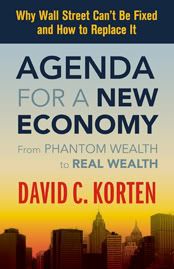
America, It's Time To Say Goodbye To Wall Street: An Interview With Author David Korten
“We face a monumental economic challenge that goes far beyond anything being discussed in the U.S. Congress or the corporate press. The hardships imposed by temporarily frozen credit markets pale in comparison to what lies ahead.Internationally renowned social scientist and historian David Korten wrote those words in the introduction of his new book, Agenda For A New Economy: From Phantom Wealth To Real Wealth, scheduled to be released by Berrett-Kohler Publishers tomorrow. Some of you may have previously read Korten’s 1995 international bestseller, When Corporations Rule the World. Longtime readers/listeners of the Intrepid Liberal Journal may also recall my August 2007 podcast interview with Korten about his book, The Great Turning: From Empire To Earth Community. You can learn more about Korten’s background by clicking here and reading the introductory text to that podcast. Korten’s current book is organized in four parts: Part I, The Case for a New Economy; Part II, The Case for Eliminating Wall Street; Part III, Agenda for a Real Wealth Economy and Part IV, Change the Story, Change the Future. Essentially, Korten divides the economy into “Wall Street” and “Main Street.” The first half of Korten’s book is dedicated to indicting Wall Street for generating “phantom wealth” at the expense of society’s quality of life. In the second half, Korten promotes twelve concepts to empower a “Main Street” economy that facilitates the exchange of tangible goods and services among citizens living within their means. His diagnosis and prescriptions are jarring. Korten postulates that Main Street is far closer to the original vision of Adam Smith while Wall Street capitalism is the antithesis of a free market economy. Reform-minded liberals, who believe we can work within America’s established financial credit markets banking system and stabilize our economy with band-aids and bailouts, will likely be just as opposed to his book as Wall Street apologists. Conservatives will likely dismiss Korten’s solutions because he believes in government regulation to ensure that businesses and citizens behave within agreed upon social norms. As Korten sees it, corporations in a Wall Street economy are given incentives to destroy the planet’s environment and inflate its financial statements by taking a wrecking ball to the middle class. In a true market economy, business entities that inflict harm on the environment and their community’s overall quality of life could not survive. Hence, Korten writes that under a Wall Street economy, corporations, “If it were a real person, it would fit the clinical profile of a sociopath.”Sadly, in American society, sociopathic behavior was rewarded as the proper spoils of capitalism. Hence, one of Korten’s twelve concepts to empower a Main Street economy is to “Reclaim the corporate charter” so that the public has a means of ensuring accountability and social responsibility. The future that Korten envisions is a community ethos in which citizens and businesses have a stake in the health, infrastructure and overall quality of life in their local community as well as the world at large. Vicki Robin, coauthor of Your Money or Your Life and cofounder of Conversation Cafes issued the following praise for Korten’s book: “Once again David Korten has provided us with a clear understanding of why the old economy is driving us and nature to ruin - and a framework for transforming it. Especially in this time of economic meltdown it's crucial for caring people everywhere to get that patching the tires of a vehicle that's going over a cliff is neither sane nor acceptable. The financial crisis is a healing crisis and Korten gives us prescriptions that could actually give us a thriving and just economy that works for people and the planet. I hope every reader feels, as I have, a sense of relief at hearing the truth and a renewed passion for civic engagement, now knowing what direction we need to steer our ship."Korten agreed to a podcast interview with me over the telephone yesterday afternoon about his latest book, why he believes the Wall Street economy is irredeemable and his solutions for the future. Our conversation was approximately forty-two minutes. Please refer to the flash media player below. Either searching for “Intrepid Liberal Journal” or “Robert Ellman” can also access this interview at no cost via the Itunes Store. |
Friday, January 30, 2009
Black History: The Greensboro Sit-Ins
 click to enlarge Birth Of A Notion Disclaimer From Wikipedia: The Greensboro sit-ins were an instrumental action in the African-American Civil Rights Movement, leading to increased national sentiment at a crucial period in American history. On February 1, 1960, four African American students – Ezell A. Blair Jr. (now known as Jibreel Khazan), David Richmond, Joseph McNeil, and Franklin McCain – from North Carolina Agricultural and Technical State University, a historically black college/university, sat at a segregated lunch counter in the Greensboro, North Carolina, Woolworth's store. This lunch counter only had chairs/stools for whites, while blacks had to stand and eat. Although they were refused service, they were allowed to stay at the counter. The next day there was a total of 28 students at the Woolworth lunch counter for the sit in. On the third day, there were 300 activists, and later, around 1000. This protest sparked sit-ins and economic boycotts that became a hallmark of the American civil rights movement. According to Franklin McCain, one of the four black teenagers who sat at the "whites only" stools:
In just two months the sit-in movement spread to 15 cities in 9 states. Other stores, such as the one in Atlanta, moved to desegregate. The media picked up this issue and covered it nationwide, beginning with lunch counters and spreading to other forms of public accommodation, including transport facilities, art galleries, beaches, parks, swimming pools, libraries, and even museums around the South. The Civil Rights Act of 1964 mandated desegregation in public accommodations. In 1993, a portion of the lunch counter was donated to the Smithsonian Institution. The Greensboro Historical Museum contains four chairs from the Woolworth counter along with photos of the original four protesters, a timeline of the events, and headlines from the media. Several documentaries have been produced about these men who sparked the sit in movement, including PBS' "February One." The sit-in movement used the strategy of nonviolent resistance, which originated in Gandhi's Indian independence movement and was later brought to the Civil Rights movement by Martin Luther King. This was not the first sit-in to challenge racial segregation. As far back as 1942, the Congress of Racial Equality sponsored sit-ins in Chicago, St. Louis in 1949 and Baltimore in 1952. In a pre-cursor to the Woolworth sit-ins, on June 23, 1957, seven students organized by a local pastor were arrested in Durham, North Carolina at the Royal Ice Shop for staging a sit-in in the "whites only" section. After being convicted in North Carolina courts, the seven appealed their case all the way to the United States Supreme Court, which refused to hear their case. On August 19, 1958, the Oklahoma City NAACP Youth Council began a six-year long campaign of sit-ins at segregated lunch counters, restaurants, and cafes in Oklahoma City. The Greensboro sit-in, however, was the most influential and received a great deal of attention in the press. BIRTH OF A NOTION WALLPAPER is now available for your computer. Click here. |
Join Wild Wild Left Radio Tonight
Join the WWL Crew: Diane G producing, Gottlieb and Ed_Encho as cohosts for a Wildly Left Show!!! Our VERY Special Guest will be OPOL, of Docudharma!!!! Tune in and Listen:  Call in with comments or questions to: 646-929-1264 The link to BTR live chat will be available on the WWL 15 minutes before the show! |
Sunday, January 25, 2009
"Bipartisanship" is not the Holy Grail
"Beck is simply wrong. As Slate recently reported, official records kept by the Architect of the Capitol show that Teddy Roosevelt did not use a Bible in 1901; and Lyndon Johnson is rumored to have used “a Catholic missal aboard Air Force One after Kennedy’s assassination.” According to his own letters, John Quincy Adams placed his hand on a constitutional law book rather than the Bible." Beck's investigations didn't include the "actual Constitution" which clearly states that no religious test for public office shall be required, thereby making the Bible, or any other religious text, token, amulet or magic charm unnecessary. It seems that the "Constitution" so often quoted in Beck's parallel universe simply doesn't contain an Article six. The constitution and strict adherence to the rule of law seemed much on the minds of Republicans this past week, a surprising fact after eight years of their support of a President who famously referred to the document as "just a goddamn piece of paper" and spent much of his two sad terms trampling it underfoot with nearly unanimous republican complicity. The party that hocked the future of our great grand children to the Chinese, set the world aflame and proved itself completely incapable of anything resembling competent governance during its twelve years of majority now seeks to instruct the new president, who hasn't yet had time to sort out his new key ring, exactly how things ought to be run. John Boehner in the House and his counterpart, Mitch McConnell, the replacement for Ted Stevens as the face of irascibility in the Senate, quickly assembled on deck a dozen or so other loose cannon to obstruct the disbursal of the next round of TARP funds and fight against Obama's stimulus package. Forget the fact that they tripped all over themselves to approve the bailout of banks and brokers under the recent stewardship of jolly King George. Following their obscene treatment of American automakers and labor they are now delaying the approval of Hilda Solis as Labor Secretary because of her support for American Labor and, worse, her support of the "Employee Free Choice Act," which corporate America is spending vast fortunes to defeat and I assume Republicans are opposed to out of something more tangible than conservative principle. They are the same old Republican Party, prowling the mall like jackals or perched buzzard like on the fences waiting for any opportunity to transfer public wealth to the ruling class, any chance to create greater disadvantage for the working class. The landscape that Republicans envision when they speak of "America" is one far different than that seen by the average Democrat. I for instance see no beauty in long lines of the unemployed waiting for a job at minimum wage or less. To a Republican that is an idyllic image, warming to the heart. Harry Truman once said: The Republicans believe that the power of government should be used first of all to help the rich and the privileged in the country. With them, property, wealth, comes first. The Democrats believe that the power of government should be used to give the common man more protection and a chance to make a living. With us the people come first. In my opinion Obama would be wise to ride his mandate, to maintain the strong cyber link to the body politic and use it to pressure the Democratic majority in the direction it would travel naturally were it not for the corrupting influence of corporate money. I would urge our new President to lose some of his zeal for the grail of "bipartisanship" and simply take his case to the people, and, like an old fashioned Democrat, govern in their name. Harry also said this: "I don't like bipartisans. Whenever a fellow tells me he's bipartisan, I know that he's going to vote against me." Bob Higgins Worldwide Sawdust |
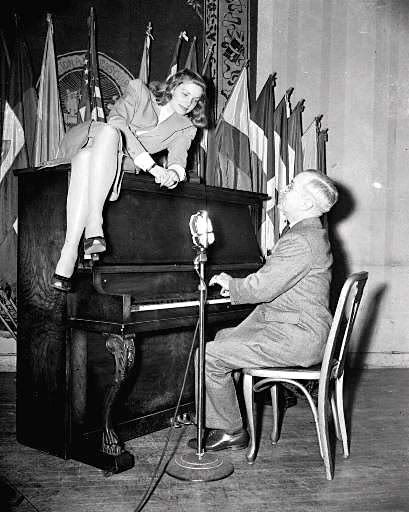 Harry Truman in a "bipartisan" moment with Lauren Bacall, a staunch liberal Democrat. This is about as "bipartisan as Harry got."
Subscribe to:
Posts (Atom)