Appearing at The Blogging Curmudgeon, My Left Wing, and the Independent Bloggers' Alliance.
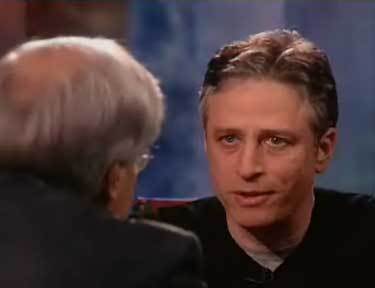
Last night "Bill Moyers Journal" aired an interview with Jon Stewart. It was one of those wonderful, rare opportunities to hear Jon Stewart speaking directly and with very little of his trademark humor. He proved once again, as he did when he took the piss out of Tucker Carlson and Paul Begala, that he is actually one of the most insightful political commentators in the business, even though he swears he's not. The entire transcript is available on the PBS site, as is a brief video excerpt. Here are some of the some of my favorite moments.
On what is and isn't journalism:
BILL MOYERS: You've said many times, "I don't want to be a journalist, I'm not a journalist."
JON STEWART: And we're not.
BILL MOYERS: But you're acting like one. You've assumed that role. The young people that work with me now, think they get better journalism from you than they do from the Sunday morning talk shows.
JON STEWART: I can assure them they're not getting any journalism from us. We are, if anything — I do believe we function as a sort of editorial cartoon. That we are a digestive process, like so many other digestive processes that go on. The thing about you know, there's a lot of young people get this and you know, young people get that from me. People are very sophisticated consumers of information, and they're pulling all different things.
It's the same argument people say about the blogs. The blogs are responsible. No, they're not. The blogs are like anything else. You judge each one based on its own veracity and intelligence and all of that. And if you like, you could cherry pick only the things that you agree with from various things. Or, if you want, you can try and get a broader perspective, or you can find people who are absolutely out of their minds, or find people that are doing incredibly complex and interesting and urgent journalism. And the same goes for our show. It's a prism into people's own ideologies, when they watch our program. This is just our take.
On how the White House uses its apparent incompetence as cover:
JON STEWART: Yeah, it's kind of astonishing. There is I used to have a real disconnect, I think, with the administration, I couldn't figure out what was going on. I think it's suddenly become clear to me. They would rather us believe them to be wildly incompetent and inarticulate than to let us know anything about how they operate. And so, they do Constitutionally-mandated things most of the time, but they don't — they fulfill the letter of their obligation to checks and balances, but not the intent.
For instance, Alberto Gonzales, and you've been watching the hearings. He is either a perjurer, or a low-functioning pinhead. And he allowed himself to be portrayed in those hearings as a low-functioning pinhead, rather than give the Congressional Committee charged with oversight, any information as to his decision-making process at the Department of Justice.
And I used to think, "They're doing this based on a certain arrogance." And now, I realize that it's because they believe there is one accountability moment for a President, and that is the four year election. And once you get that election, you're done.
BILL MOYERS: They're right, are they not?
JON STEWART: They're completely not right. The election moment is merely the American public saying, "We'd rather you be President than that guy." That's it. The next four years, though, you still have to abide by the oversight process that is there to prevent this kind of bizarre sort of cult-like atmosphere that falls along. I mean, I accept that kind of veil of secrecy around Tom Cruise and Katie Holmes, but I don't accept that around our government.
On Alberto Gonzales as Henry Hill in the Bush Mob:
BILL MOYERS: Tens of thousands, hundreds of thousands of words were written about Gonzales' testimony last week in Congress. And I still don't think a lot of people get it. And all of the sudden, there on THE DAILY SHOW that evening, you distilled the essence of it.
JON STEWART: And by the way, that was all just — that was a game, and he knew it, and the guys on the committee knew it. And for the President to come out after that and say, "Everything I saw there gave me more confidence in him," that solidified my notion that, "Oh, it's because what he expected of Gonzalez was" it's sort of like, do you remember in GOODFELLAS? When Henry Hill got arrested for the first time and Robert DeNiro met him at the courthouse and Henry Hill was really upset, 'cause he thought Robert DeNiro would be really mad at him. And DeNiro comes up to him and he gives him a $100 and he goes, "You got pinched. We all get pinched, but you did it right, you didn't say nothing."
BILL MOYERS: Gonzales said nothing.
JON STEWART: Right. And "you went up there and said nothing. You gave them no legal recourse against you, and you made yourself a smart man, a self-made man look like an utter pinhead on national television, and you did it for me."
On the iconic interview with John McCain:
BILL MOYERS: You know, we watched the McCain interview you did this week. Something was going on in that interview that I have not seen in any other interview you've done with a political figure. What was going on in your head?
JON STEWART: In my head?
BILL MOYERS: Yeah.
JON STEWART: Are his arms long enough to connect with me if he comes across the table?...
JON STEWART: I don't particularly enjoy those types of interviews, because I have a great respect for Senator McCain, and I hate the idea that our conversation became just two people sort of talking over each other, at one point.
But I, also, in my head, thought, I would love to do an interview where it's just sort of de-constructed — the talking points of Iraq — sort of the idea of, is this really the conversation we're having about this war? That if we don't defeat Al Qaeda in Iraq, they'll follow us home? That to support the troops means not to question that the surge could work. That, what we're really seeing in Iraq is not a terrible war, but in fact, just the media's portrayal of it. So, I wanted to just go through-- like, is this really the conversation that we're going other be having about something as significant as this war?
On the devolution of American politics:
BILL MOYERS: Why aren't we having that conversation? Well, that's a very good point, Why is the country not having this conversation, the kind of conversation that requires the politicians who are responsible for the war to be specific to the concerns of the American people. I mean, they do come out and a kind of gauze goes up.
JON STEWART: Because I don't think politics is any longer about a conversation with the country. It's about figuring out how to get to do what you want. The best way to sell the product that you want to put out there, but not necessarily for the products on you know, it-- it's sort of like, when a dishwashing soap you know, they want to make a big splash, so they decide to have more lemon, as though people are gonna be like, "That has been the problem with my dishes! Not enough lemon scent!"
On our lack of shared sacrifice and why there will be no draft:
JON STEWART: It's very hard to feel the difficulties that the military goes through. It's very hard to feel the difficulties of military families, unless you're in that environment. And sometimes you have to force yourself to try and put yourself in other people's sort of shoes and environment to get the sense of that.
JON STEWART: You know, one of the things that I do think government counts on is that people are busy. And it's very difficult to mobilize a busy and relatively affluent country, unless it's over really crucial-- you know, foundational issues. That come sort of sort of a tipping point.
BILL MOYERS: War? War?
JON STEWART: But war that hasn't affected us here, in the way that you would imagine a five-year war would affect a country. I think that's why they're so really — here's the disconnect. It's sort of this odd and I've always had this problem with the rationality of it. That the President says, "We are in the fight for a way of life. This is the greatest battle of our generation, and of the generations to come. "And, so what I'm going to do is you know, Iraq has to be won, or our way of life ends, and our children and our children's children all suffer. So, what I'm gonna do is send 10,000 more troops to Baghdad."
So, there's a disconnect there between — you're telling me this is fight of our generation, and you're going to increase troops by 10 percent. And that's gonna do it. I'm sure what he would like to do is send 400,000 more troops there, but he can't, because he doesn't have them. And the way to get that would be to institute a draft. And the minute you do that, suddenly the country's not so damn busy anymore. And then they really fight back, and then the whole thing falls apart. So, they have a really delicate balance to walk between keeping us relatively fearful, but not so fearful that we stop what we're doing and really examine how it is that they've been waging this.
On his role in the political conversation:
JON STEWART: I don't consider myself a serious and social political critic.
BILL MOYERS: But I do. And I'm your audience.
As do I, Bill. As do I.
|