






Appearing at The Jaundiced Eye, the Independent Bloggers' Alliance, and My Left Wing. Recently, in her Huffington Post blog, Naomi Wolf compared Sarah Palin to Eva Peron. Now, there's an analogy that becomes more apt every day. Like any peasant girl from the outskirts, Sarah Palin needs to dress the part of a political luminary. While Palin's transformation from hockey mom to fashion plate has raised eyebrows, her "SNL" character, played by Tina Fey, has remained firmly in the red jacket. And according to Women's Wear Daily's Irin Carmon, "SNL" costume designer Tom Broecker said Wednesday night that dressing Palin for last Saturday's cameo required a compromise:Of Palin, Broecker said, "In speaking with her, I had to get her to understand why she needed to wear the same thing as Tina [Fey]. We had gone off and created it for the first time a month ago, a look we identified as Sarah Palin. She had moved on in her own image of herself. I said, 'I know you've moved on you're wearing tighter clothes, more black but this is the character of Sarah Palin.'" Silly SNL dresser. She needs to dress for her descamisados, up there in Alaska. (They're very cold.) Besides, as John McCain says, "She needed clothes." (Well, ok. But does her seven year old really need a Louis Vuitton bag?) The McCain campaign assures us the clothes will go to charity. What they don't tell you: She'll be throwing them from a balcony. "Please understand what you are looking at when you look at Sarah "Evita" Palin. You are looking at the designated muse of the coming American police state." -- Naomi Wolf |
Showing posts with label Economic Populism. Show all posts
Showing posts with label Economic Populism. Show all posts
Thursday, October 23, 2008
Sarah Palin and the Religion of Ecstacy


Sunday, February 3, 2008
Another Reason to Hate Hillary
Appearing at The Jaundiced Eye, the Independent Bloggers' Alliance, and My Left Wing. 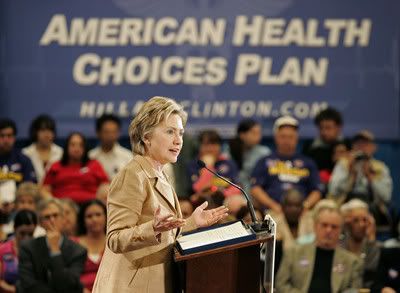 She wants to pick your pocket. Democrat Hillary Rodham Clinton said Sunday she might be willing to have workers' wages garnisheed if they refuse to buy health insurance to achieve coverage for all Americans. Because we all know how good the federal government is at determining what is affordable for average American workers. Just ask all those "Welfare to Work" mothers. Of course it may be hard to reach them between shifts of the two or three jobs many of them work to keep their kids clothed, fed and in daycare. Yes, Hillary, in her infinite wisdom, has deduced that the ones responsible for our broken health care system aren't insurance companies or pharmaceutical companies or employers who are slashing benefits and pay raises, simultaneously. It's those flush workers who just refuse to pay for insurance. Make no mistake. This is yet another Republicrat idea designed to utterly fuck the middle class. But, if Obama is smart, he will take this ball and run with it, because Hill has just handed him a hell of a campaign issue right before Super Tuesday. "Hillary wants to garnish your wages." It just writes itself. |
Monday, September 3, 2007
Some Thoughts On Labor Day
Appearing at The Jaundiced Eye, the Independent Bloggers' Alliance, and My Left Wing. This is the opening sequence from what I believe is one of the most under appreciated movies of all time, "Joe Versus the Volcano." Protagonist Joe Banks undertakes a Joseph Campbellesque "hero's journey," which frees him from the illusory demands of wage slavery. Anyone who has seen the movie will recognize the elements of Campbell's "monomyth." This fundamental structure contains a number of stages, which include (1) a call to adventure, which the hero has to accept or decline, (2) a road of trials, regarding which the hero succeeds or fails, (3) achieving the goal or "boon," which often results in important self-knowledge, (4) a return to the ordinary world, again as to which the hero can succeed or fail, and finally, (5) application of the boon in which what the hero has gained can be used to improve the world. The story-line also incorporates many elements which would be familiar to shamanic practitioners; most notably the symbolic death/rebirth experience which frees the man from the limitations of the ego. "Man is born free, but is everywhere in chains." -- Jean-Jacques Rousseau |
Saturday, July 28, 2007
There's just gotta be a better way
I spent much of yesterday working some very tedious Cafe Press stuff. The section in question isn't even done yet, and I'm not that thrilled with it, so I'm not linking to it directly. But while I was working on that, Doctor Who came on. The television is on Demetrius' desk, and usually he puts on headphones if I'm in the room--since, if I'm in here, I'm probably trying to work on something, and my concentration is shot pretty easily. But today, when he asked if I'd like to hear the show, I said yes, given that I was working on something pretty mindless, and listening to the same show together was the closest we're going to get to "spending time together" yesterday.
|


Tuesday, June 5, 2007
More Stuff Our Children Isn't Learning
Appearing at The Blogging Curmudgeon, My Left Wing, and the Independent Bloggers' Alliance.  Via David Sirota, a freshly minted article in the Financial Times provides still more evidence that what we learn isn't what we earn.
This isn't exactly news, of course. It's just more evidence against the canard that has allowed free trade enthusiasts to put American workers in direct competition with third world employment markets. 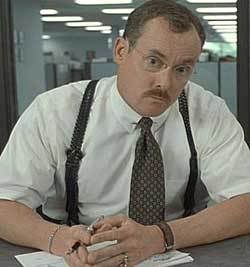 BOB PORTER -- It looks like you've been missing a lot of work lately. BOB PORTER -- It looks like you've been missing a lot of work lately.PETER -- I wouldn't say I've been missing it, Bob. BOB SLYDELL -- That's terrific, Peter. I, I, I'm sure you've, you've, you've heard some of the rumors around the hallway about how we're just going to do a little housecleaning with some of the software people. PETER -- Well, Bob, I have heard that and you gotta do what you gotta do. BOB PORTER -- Well, these people here. First, Mr. Samir Naga... Naga... BOB SLYDELL -- Naga... BOB PORTER -- Naga-worker here anyway! BOB SLYDELL -- Mr. Mike Bolton. We're certainly gonna miss him. PETER -- You're gonna layoff Samir and Michael!? BOB PORTER -- We're gonna bring in some entry level graduates for us to work in Singapore, that's the usual deal. BOB SLYDELL -- Well, it's standard operating procedure. As I wrote here, over a year ago, a good education is not a panacea for what ails our weakening job market. As per Harold Meyerson of the Washington Post. Also dying, if not yet also kaput, is the comforting notion that a good education is the best defense against the ravages of globalization -- or, as Bill Clinton famously put it: What you earn is the result of what you learn. A study last year by economists J. Bradford Jensen of the Institute for International Economics and Lori Kletzer of the University of California at Santa Cruz demonstrates that it's the more highly skilled service-sector workers who are likely to have tradable jobs. And according to the Bureau of Labor Statistics, the proportion of jobs in the United States that require a college degree will rise by a measly one percentage point -- from 26.9 percent in 2002 to 27.9 percent in 2012 -- during this decade. So what kinds of jobs will the global marketplace provide for America's college graduates? Again, from Meyerson: In the new global order, Blinder writes, not just manufacturing jobs but a large number of service jobs will be performed in cheaper climes. Indeed, only hands-on or face-to-face services look safe. 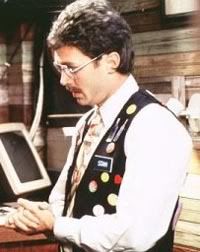 STAN -- I need to talk about your flair. STAN -- I need to talk about your flair.JOANNA -- Really? I have 15 buttons on. I, uh... STAN -- Well, ok, 15 is minimum, ok? JOANNA -- Ok. STAN -- Now, it's up to you whether or not you want to just do the bare minimum. Well, like Brian, for example, has 37 pieces of flair. And a terrific smile. JOANNA -- Ok. Ok, you want me to wear more? STAN -- Look. Joanna. JOANNA -- Yeah. 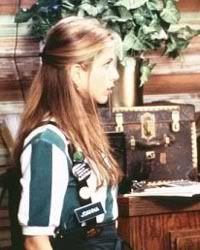 STAN -- People can get a cheeseburger anywhere, ok? They come to Chotchkie's for the atmosphere and the attitude. That's what the flair's about. It's about fun. STAN -- People can get a cheeseburger anywhere, ok? They come to Chotchkie's for the atmosphere and the attitude. That's what the flair's about. It's about fun.JOANNA -- Ok. So, more then? STAN -- Look, we want you to express yourself, ok? If you think the bare minimum is enough, then ok. But some people choose to wear more and we encourage that, ok? You do want to express yourself, don't you? JOANNA -- Yeah. Yeah. STAN -- Great. Great. That's all I ask. JOANNA -- Ok. But a few studies by reputable researchers will not stop factually challenged, globalization apologists like Thomas Friedman from trotting out the education myth at every opportunity. It's far too useful as a tool for shutting down debate on outsourcing. And all this bloviating about the importance of education isn't slowing the erosion of an economy that now sees a decline in income for 90% of the populace. It's not doing a whole lot for our educational system either. My daughter started kindergarten this year. She's lucky. She's in a top-rated school district; not one that has being punitively starved for being malnourished to begin with. I did learn, however, what accounts for a good education these days. It starts with homework for 5 year olds. It's not like the kindergarten of my memory. I colored and made macaroni necklaces. She has a math test every week. Did I mention that she's 5? So, my husband and I did a little research and learned, to our horror, that 5 is really not an appropriate age for today's kindergarten, and that parents all over the country are pressing their school districts to hold their kids back a year, called "redshirting," so they can keep up with the rigorous demands of the kindergarten classroom. Children who turn 5 even in June or earlier are sometimes considered not ready for kindergarten these days, as parents harbor an almost Darwinian desire to ensure that their own child is not the runt of the class. Although a spate of literature in the last few years about boys' academic difficulties helped prompt some parents to hold their sons back a year, girls, too, are being held back. Yet research on whether the extra year helps is inconclusive. While the push to make our kids more "competitive" is resulting in grade school standards that are increasingly out of sync with normal, developmental stages, politician's and the corporations that pull their strings enjoy endless benefits. The political emphasis on education does even more for corporate America than provide a fig leaf for outsourcing all our jobs to India and China. Long before "No Child Left Behind" started making millions for Neil Bush, pharmaceutical companies learned they could profit by medicating our "disruptive" kids. The problem traces back to a dubious study called "A Nation at Risk," which correlated our educational system with the ebb and flow of the greater economy. One result is an increase in diagnoses of ADD/ADHD and prescriptions for drugs like Ritalin. Despite the unsoundness of the conceptual underpinnings of A Nation at Risk, the 1983 report led to a substantial rewriting of federal and state laws regarding education. Many states now employ "high stakes" testing, which, by definition, means that state funding is allocated preferentially to school districts showing the greatest improvement in test scores. Principals are hired or fired depending on their school's test score results. Superintendents are promised large bonuses if their school districts' test scores rise; if the scores fall, a superintendent will likely be sacked. School test scores now affect many aspects of a community's self-image, including property values. If your family has to choose between moving to town A or town B, and A's schools get higher test scores than B's, aren't you more likely to move to town A? Other things being equal, the town with higher scores will have higher property values. My daughter can write her own name, now. Most of the time the letters are well-proportioned and face in the right direction. A few weeks ago, she finally grokked the relevance of "homework." Well, better late than never. At this rate, by the time she graduates from college she should be well prepared to compete for a job against a commensurately educated Vietnamese worker who will work for pennies on the dollar... Or she can always waitress. I think she has a real flair for "flair." She'll probably need it. |
Friday, March 30, 2007
Reagan's Legacy: Executive Amnesia
  There's a very clever graphic on the cover of The Huffington Post this morning. A Warholesque pattern of 122 images of ex-Gonazales aide Kyle Sampson. One for every memory lapse he reported on the Senate floor yesterday. "I don't remember." Get used to that phrase. We'll be hearing it a lot in the coming weeks and months. Reagan did it with an actor's flair, but it was Reagan who ushered in this age of executive exceptionalism. "I cannot recall," he said over and over in his Iran-Contra testimony. And with that endearing little nod, that seemed to say, "Why I am just a simple man. A man of the people, baffled by these dark political machinations." I remember my grandfather cluck, cluck, clucking in disgust. "If he were the CEO of a company," he'd say, "You know how long he'd be tellin' that story? About as long as it took him to grab his things and walk to the front gate." But my grandfather was one of those men in "gray flannel" Paul Krugman writes about. He was the product of that bygone era, when the buck actually stopped somewhere. This is Reagan's legacy. An era of unaccountability for those who achieve the requisite wealth and influence. A time when men of small skill, but excellent breeding, fail ever upwards and descend, when they do, on golden parachutes. An era when only the little people experience the consequences, not only of their personal failings, but of the colossal failings of their "betters." When average workers of a company like Enron lose their livelihoods, their savings, their homes. But can only stare in rapt amazement as the wheels of justice grind slowly on, bringing few prosecutions and vacating that of a dead architect of corporate failure. There is no "pound 'em in the ass prison" for even token prosecutions like Scooter Libby. That nice white boy shouldn't see the inside of a jail cell says even his jury. He didn't mean any harm. He was just so forgetful. Crossposted from The Blogging Curmudgeon. |
Subscribe to:
Posts (Atom)