


Sunday, June 21, 2009

Living On $2 A Day: An Interview With Economist Jonathan Morduch
The topic below was originally posted on my blog, the Intrepid Liberal Journal.

According to the World Bank, almost forty percent of humanity lives on a daily income of less than two dollars per day. Another 1.1 billion scrape by on less than one dollar per day.

How can anyone possibly survive or raise a family with such a meager income? In New York City, two dollars per day won’t even cover my daily Brooklyn/Manhattan round-trip subway commute. Yet billions of low skilled people put food on the table, educate their children, grapple with unexpected emergencies and even save money.

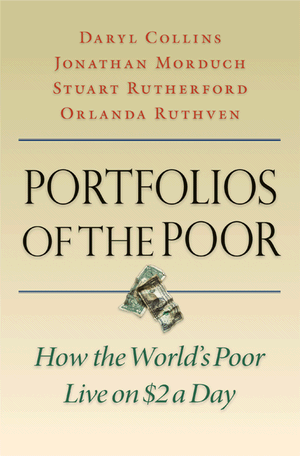
In Portfolios of the Poor: How the World’s Poor Live On $2 a Day, Darryl Collins, Jonathan Morduch, Stuart Rutherford and Orlanda Ruthven, compiled yearlong “financial diaries,” of villagers and slum dwellers in Bangladesh, India and South Africa. The diaries track penny by penny, how specific households manage their money with sophistication and resourcefulness. Recently published by Princeton University Press, Portfolios of the Poor, presents revealing data in an accessible seven chapters and 184 pages of text. The text is supported with an additional eighty plus pages of appendices, data tables and notes illustrating “the story behind the portfolios.”

In a tour de force of primary research, the authors report that the world’s poorest do not live hand to mouth and desperately spend what they earn just to keep from drowning. Instead, they utilize financial tools, rely on “informal” networks through relatives and neighbors and navigate perils such as medical calamities and political strife. Their stories are both inspiring as well as heartbreaking.

Although the world’s poorest are far more adept at financial management then previously understood, they’re confronted with what the authors describe as the “triple whammy”:

  • Low income
  • Irregularity of income.
  • Unpredictability about when they will earn income.
Hence, the authors assertively advocate for microfinancing as a means of empowering the world’s poorest with more secure and convenient instruments to access and manage money. Microfinancing is financial services for low income clients in the world’s poorest countries who are self-employed or operating their own businesses.

The authors argue in their book that microfinancing should also be extended to address the needs of exceptionally low-income wage earners as well. It is their contention that poor people in the countries they researched demonstrate on a daily basis that they are responsible money managers and would also be reliable clients of microfinancing services.

One of the authors, Jonathan Morduch, is a New York University ("NYU") professor of economics as well as a managing director of the Financial Access Initiative - a consortium of researchers at NYU, Harvard, Yale, and Innovations for Poverty Action. Morduch, agreed to a telephone podcast interview with me about the book and our conversation was just under twenty-six minutes.

Among the topics covered was how his team earned the confidence of the people they interviewed, the informal market tools utilized by the world’s poorest in Bangladesh, India and South Africa and why he’s a proponent of extending microfinancing to the world’s poorest wage earners.

Please refer to the flash media player below.


This interview can also be accessed at no cost via the Itunes Store by searching for either the “Intrepid Liberal Journal” or “Robert Ellman.

Friday, June 12, 2009

An Example of Left Wing Violence

Crossposted from Left Toon Lane, Bilerico Project & My Left Wing


click to enlarge

I find it laughable when the likes of Rush Limbaugh and other neo-con side-shows claim von Brunn was a leftist. They further their train of thought to claim this was left wing violence.

In today’s strip… let’s just say it was a recent real life scene from a Berkeley restaurant.

Tuesday, June 9, 2009

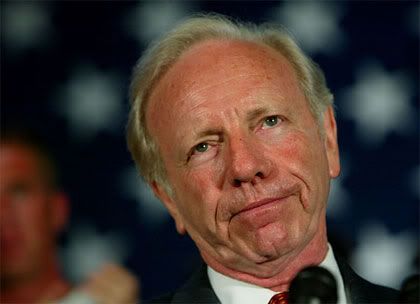
Joe Lieberman: Hypocrite Extraordinaire

Appearing at The Jaundiced Eye, the Independent Bloggers' Alliance, and My Left Wing.

Photobucket


Joe Lieberman then:

HAVING SPENT much of the past year mired in legislative trench warfare over Iraq, advocates in Congress seeking a mandatory withdrawal of troops are now refusing to pass funding for our forces deployed in Iraq or Afghanistan.

For Congress to fail to provide the funds needed by our soldiers in the field is inexcusable under any circumstances -- but it is especially disappointing right now, coming at the very moment when Gen. David Petraeus and his troops are achieving the kind of progress in Iraq that few would have dared imagine possible just a few months ago. [emphasis added]

A very petulant Joe Liberman now:

Sens. Joseph Lieberman (I-Conn.) and Lindsey Graham (R-S.C.) lambasted transparency advocates at a press conference Tuesday, when they renewed their promise to bring Senate business to a halt until their bill blocking the release of detainee photographs becomes law.

"We're not going to do any more business in the Senate," Graham said, his face flushed red. "Nothing's going forward until we get this right."

The duo's bill, which would allow the Pentagon to exempt Bush-era photos from the Freedom of Information Act, was stripped from the conference version of the war supplemental Monday night. In anticipation of trouble, Lieberman and Graham had already inserted the bill into the tobacco-regulatory legislation currently on the floor of the Senate.

By turns sober and furious, the two senators vowed again Tuesday to vote against -- and, if possible, filibuster -- the troop-funding bill and all other legislation until they get their way. They equated the weapons supplied by the war supplemental spending bill with detainee photos that they said would serve as a recruiting tool for al-Qaida and a weapon against U.S. troops. [emphasis added]


So... who's playing politics with the troops?

Sunday, June 7, 2009

Billy Graham & the Rise of the Republican South: An Interview With Historian Steven P. Miller

The topic below was originally posted on my blog, the Intrepid Liberal Journal.

In the age of Barack Obama, both the Republican Party as well as the South appear marginalized and out of step with the rest of America. Yet it wasn’t so long ago that the South represented the foundation of America’s conservative hegemony. Starting with Dwight Eisenhower in 1952, the Republican Party prevailed in nine out of the next fourteen presidential elections with a reliable Southern base.

Specifically, the Republican Party exploited white Southern resentment against the cause of civil rights and integration. The "Southern strategy" as it was later called, enabled Republicans to end the Democratic Party's previous domination of the South following the Civil War. A key figure in that realignment was the renowned evangelist Billy Graham.

Historian, Steven P. Miller, first explored Billy Graham’s role in this realignment with his doctorate thesis entitled, “The Politics of Decency: Billy Graham, Evangelicalism, and the End of the Solid South, 1950-1980.” Miller later converted that thesis into his current book, Billy Graham and the Rise of the Republican South, recently published by the University of Pennsylvania Press. Miller’s book delineates how Graham allowed his iconic celebrity to be used by national politicians so they could make inroads into the South. His book also details how Graham capitalized on his leverage as a regional heavyweight to influence presidents and policy.

With President Dwight Eisenhower, Graham had an ideological soul mate as both valued “moderation” between segregationists and those who championed integration. Graham believed that racism could not be overcome through legislation and the heavy hand of federal power. Instead, he advocated changing the hearts and minds of people “one soul at a time” through his integrated “crusades” where he preached his love thy neighbor gospel.

Under the presidencies of Truman, Eisenhower, Kennedy, Johnson and Nixon, Graham straddled the fence between promoting racial tolerance and preserving local southern autonomy or “states rights.” In that regard, Graham was an intimate part of Richard Nixon's inner circle after he became president in 1968. Graham’s defenders argue that he helped the South transition from its shameful past while preserving stability. His critics claim that Graham was a cowardly apologist for white privilege who didn’t do nearly enough to advance the cause of civil rights. Personally, like many liberals, I'm partial to the latter argument.

Ross Douthat writes in his April 19th review of Miller's book in the New York Times that,

“Neither story is the whole truth, but both are true. And it’s a credit to Steven P. Miller that his ‘Billy Graham and the Rise of the Republican South,’ a study of the evangelist’s relationship to the cause of civil rights on the one hand and the cause of conservatism on the other, does justice to the tensions and complexities involved — for Graham, for the South and for the country. In Miller’s account, one of 20th-century America’s most important religious leaders emerges as a representative political actor as well, whose example is worth pondering less because he was courageous than because he often wasn’t.

The story of the civil rights era is usually told as a collision between heroes and villains: the marchers on one side and the K.K.K. on the other; the Martin Luther Kings and Lyndon Johnsons making the way straight for justice, and the George Wallaces and Bull Connors standing sneering in their way. But the movement’s successes and failures were ultimately determined by the choices of more unheroic men — men like Billy Graham.”
Miller, who earned a PH.D degree in history from Vanderbilt University and has taught at numerous institutions, including Washington University, Webster University and Goshen College, agreed to a telephone podcast interview with me about his book and our conversation was just under thirty-six minutes.

Among the topics covered is the difference between hard core fundamentalism and evangelicalism, Graham’s role in facilitating Republican inroads into the previously reliable Democratic South, whether his middle ground on civil rights was courageous or cowardly, Graham's alliance with Eisenhower, his friendship with Lyndon Johnson, the intimate collaboration with Richard Nixon and the legacy he left behind.

Please refer to the flash media player below.


This interview can also be at accessed at no cost via the Itunes Store by searching for either the “Intrepid Liberal Journal” or “Robert Ellman.”

Saturday, June 6, 2009