






If you go to Wickipedia, it explains "race realism" as the claim that races are real rather than social constructs, and that racial distinctions are enduringly important because racial groups differ by nature (genetically) with regard to such important behavioral tendencies as intelligence and impulsiveness. This claim holds that racial distinctions are real and measurable, and further claims those measurable differences are based in science instead of idealism. Examples of scientifically demonstrable racial distinctions are said to include different decision and reaction times, intelligence, crime rates, and medical characteristics, such as differing tendencies toward diseases such as osteoporosis or sickle cell anemia.[1] Critics often claim that racial realism is a euphemism for scientific racism. I would agree. |
Wednesday, January 6, 2010
So-Called "Race Realism": A Reaction


Thursday, September 24, 2009
"Skinhead", A Poem by Patricia Smith
|


Thursday, February 26, 2009
Watermelons on the White House Lawn
 Photo: Keyanus Price Photo: Keyanus PriceWouldn't it be funny to send out an email of the White House with watermelons on the lawn? Orange, California mayor Dean Grose thought so. It was an adolescent attempt at humor that he thought he'd share with a few friends. Not everyone thought it was funny. I know there's absolutely nothing wrong with watermelons growing on the White House lawn but now that Barack Obama is President, it has special significance. Now I know Mayor Grose didn't mean anything by this email and is surprised that anyone would be offended by it. It's only watermelons, what's the big deal? From Tim Rice, a prominent anti-racist commentator, comes the best observation: White Denial once again...so this guy says, "Oh sorry, I didn't know watermelons had a racial connotation..."I guess the next thing we're going to see is cotton in the Rose Garden or Michelle Obama as Aunt Jemima. But of course, nothing wrong with that since Aunt Jemima is on the shelf of every supermarket and grocery store. Aunt Jemima is an American icon and cotton is a natural fiber. Next up, 40s, nooses and black Sambo dolls. |
Monday, October 20, 2008
The Colin Powell Countdown Calendar
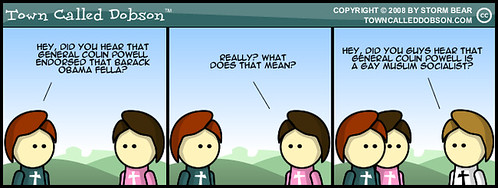 click to enlarge I was blown away by Powell's endorsement of Obama and televised spanking of McCain and Palin. Powell has always had the ability to formulate his sentences in a manner that is plain spoken yet leaves no question about what he said. John McCain sucks and General Colin Powell knows it. What will the McCain response will be? I think he can only respond in one way and that is to start tearing down Colin Powell. So here is my question, how long will it take for someone to call General Colin Powell gay, a Muslim or a socialist? Limbaugh has already called Powell a racist, so socialist can't be too far away. |
Wednesday, October 8, 2008
McCain to Black America: You Don’t Matter
 click to enlarge Last night's debate was a huge loss and campaign mess for the McCain camp. McCain clearly lost the debate, even Fox News agrees to this. McCain lost RedState.com readers and Free Republicers - his core wingnuts. But more importantly McCain displayed his internal racial hatred for African Americans. Last night when he was asked a question by a member of the audience, McCain would turn and face them, in fact, he would get right in front of them and engage the questioner one-on-one. He even shook the hand of one man. This is true unless you were Black. When Blacks asked the question, McCain treated each one with disrespect. He called one Black gentleman the wrong name, he was condescending to another in reference to Fannie Mae and then there was Ingrid. Ingrid, a Black woman, asked McCain a question on how he would get Congress moving fast to on environmental issues. McCain didn't look her in the eye, he turned his back to her and started chatting with a white guy. This is more evidence of what I call McCain's Folksy Racism, they are non-verbal cues, body language that belies the true feelings of an individual. He embraces the White folks and ignores the Blacks. Probably the thing that makes him the most angry is that he cannot ignore Obama. Lastly, I found it remarkable that McCain left the debate floor within seconds of the end of the debate, the Obamas, hung-out and shook hands and took pictures with the audience. This went on for awhile... and the news outlets let the cameras roll. |
Saturday, September 6, 2008
I Don't Think That Word Means What You Think It Means
|


Monday, August 11, 2008
Black History: Loving vs. Virginia
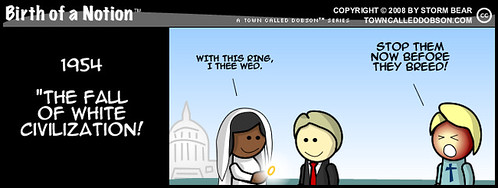 click to enlarge Loving v. Virginia, 388 U.S. 1 (1967), was a landmark civil rights case in which the United States Supreme Court declared Virginia's anti-miscegenation statute, the "Racial Integrity Act of 1924", unconstitutional, thereby overturning Pace v. Alabama (1883) and ending all race-based legal restrictions on marriage in the United States. The plaintiffs, Mildred Loving (nee Mildred Delores Jeter, a woman of African and Rappahannock Native American descent, 1939 – May 2, 2008) and Richard Perry Loving (a white man, October 29, 1933 – June 1975), were residents of the Commonwealth of Virginia who had been married in June 1958 in the District of Columbia, having left Virginia to evade the Racial Integrity Act, a state law banning marriages between any white person and any non-white person. Upon their return to Caroline County, Virginia, they were charged with violation of the ban. Specifically, they were charged under Section 20-58 of the Virginia Code, which prohibited interracial couples from being married out of state and then returning to Virginia, and Section 20-59, which classified "miscegenation" as a felony punishable by a prison sentence of between one and five years. On January 6, 1959, the Lovings pleaded guilty and were sentenced to one year in prison, with the sentence suspended for 25 years on condition that the couple leave the state of Virginia. The trial judge in the case, Leon Bazile, echoing Johann Friedrich Blumenbach's 18th-century interpretation of race, proclaimed that
The Lovings moved to the District of Columbia, and on November 6, 1963 the American Civil Liberties Union filed a motion on their behalf in the state trial court to vacate the judgment and set aside the sentence on the grounds that the violated statutes ran counter to the Fourteenth Amendment. This set in motion a series of lawsuits which ultimately reached the Supreme Court. On October 28, 1964, after their motion still had not been decided, the Lovings began a class action suit in the U.S District Court for the Eastern District of Virginia. On January 22, 1965, the three-judge district court decided to allow the Lovings to present their constitutional claims to the Virginia Supreme Court of Appeals. Virginia Supreme Court Justice Harry L. Carrico (later Chief Justice of the Court) wrote an opinion for the court upholding the constitutionality of the anti-miscegenation statutes and, after modifying the sentence, affirmed the criminal convictions. Ignoring United States Supreme Court precedent, Carrico cited as authority the Virginia Supreme Court's own decision in Naim v. Naim (1955), and also argued that the case at hand was not a violation of the Fourteenth Amendment Equal Protection Clause because both the white and the non-white spouse were punished equally for the "crime" of "miscegenation", an argument similar to that made by the United States Supreme Court in 1883 in Pace v. Alabama. In 1966, the Presbyterian Church took a strong stand stating that they do not condemn or prohibit interracial marriages. The church found "no theological grounds for condemning or prohibiting marriage between consenting adults merely because of racial origin". In that same year, the Unitarian Universalist Association declared that "laws which prohibit, inhibit or hamper marriage or cohabitation between persons because of different races, religions, or national origins should be nullified or repealed." Months before the Supreme Court ruling on Loving v. Virginia the Roman Catholic Church joined the movement, supporting interracial couples in their struggle for recognition of their right to marriage. Prior to Loving v. Virginia there were several cases on the subject of race mixing cases. In Pace v. Alabama (1883) the Supreme Court ruled that the conviction of an Alabama couple for interracial sex, affirmed on appeal by the Alabama Supreme Court, did not violate the Fourteenth Amendment. Interracial extramarital sex was deemed a felony, whereas extramarital sex ("adultery or fornication") was only a misdemeanor. On appeal, the United States Supreme Court ruled that the criminalization of interracial sex was not a violation of the equal protection clause because whites and non-whites were punished in equal measure for the offense of engaging in interracial sex. The court did not need to affirm the constitutionality of the ban on interracial marriage that was also part of Alabama's anti-miscegenation law, since the plaintiff, Mr. Pace, had chosen not to appeal that section of the law. After Pace v. Alabama, the constitutionality of anti-miscegenation laws banning marriage and sex between whites and non-whites remained unchallenged until the 1920s. In Kirby v. Kirby (1921), Mr. Kirby asked the state of Arizona for an annulment of his marriage. He charged that his marriage was invalid because his wife was of ‘negro’ descent, thus violating the state's anti-miscegenation law. The Arizona Supreme Court judged Mrs. Kirby’s race by observing her physical characteristics and determined that she was of mixed race, thereby granting Mr. Kirby’s annulment. In the Monks case (Estate of Monks, 4. Civ. 2835, Records of California Court of Appeals, Fourth district), the Superior Court of San Diego County in 1939 decided to invalidate the marriage of Marie Antoinette and Allan Monks because she was deemed to have "one eight negro blood". The court case involved a legal challenge over the conflicting wills that had been left by the late Allan Monks, an old one in favor of a friend named Ida Lee and a newer one in favor of his wife. Lee's lawyers charged that the marriage of the Monkses, which had taken place in Arizona, was invalid under Arizona state law because Marie Antoinette was "a Negro" and Alan had been white. Despite conflicting testimony by various expert witnesses, the judge defined Mrs. Monks' race by relying on the anatomical "expertise" of a surgeon. The judge ignored the arguments of an anthropologist and a biologist that it was impossible to tell a person's race from physical characteristics. Monks then challenged the Arizona anti-miscegenation law itself, taking her case to the California Court of Appeals, Fourth District. Monks's lawyers pointed out that the anti-miscegenation law effectively prohibited Monks as a mixed-race person from marrying anyone: "As such, she is prohibited from marrying a negro or any descendant of a negro, a Mongolian or an Indian, a Malay or a Hindu, or any descendants of any of them. Likewise ... as a descendant of a negro she is prohibited from marrying a Caucasian or a descendant of a Caucasian...." The Arizona anti-miscegenation statute thus prohibited Monks from contracting a valid marriage in Arizona, and was therefore an unconstitutional constraint on her liberty. The court, however, dismissed this argument as inapplicable, since the case presented involved not two mixed-race spouses but a mixed-race and a white spouse: "Under the facts presented the appellant does not have the benefit of assailing the validity of the statute." Dismissing Monks's appeal in 1942, the United States Supreme Court refused to reopen the issue. The turning point came with Perez v. Sharp (1948), also known as Perez v. Lippold. In Perez, the Supreme Court of California recognized that interracial bans on marriage violated the Fourteenth Amendment of the Federal Constitution. The U.S. Supreme Court overturned the convictions in a unanimous decision, dismissing the Commonwealth of Virginia's argument that a law forbidding both white and black persons from marrying persons of another race, and providing identical penalties to white and black violators, could not be construed as racially discriminatory. The court ruled that Virginia's anti-miscegenation statute violated both the Due Process Clause and the Equal Protection Clause of the Fourteenth Amendment. In its decision, the court wrote:
The Supreme Court concluded that anti-miscegenation laws were racist and had been enacted to perpetuate white supremacy:
Despite this Supreme Court ruling, such laws remained on the books, although unenforced, in several states until 2000, when Alabama became the last state to repeal its law against mixed-race marriage. The definition of a marriage and what constitutes a family was reconsidered by society after the decision of Loving v. Virginia. Following Loving v. Virginia, The Changing Nature of Interracial Marriage in Georgia: A Research Note states "there was a 448 per cent increase in the number of interracial marriages. These numbers are only from the state of Georgia after the Supreme Court ruling, but the numbers and percentages only continued to increase across the United States. However, interracial couples still had to overcome many fears of possibly losing respect from friends, family, and the community. Some activists believe that the Loving ruling will eventually aid the marriage equality movement for same-sex partnerships, if courts allow the Equal Protection Clause to be used. F.C. Decoste states, "If the only arguments against same sex marriage are sectarian, then opposing the legalization of same sex marriage is invidious in a fashion no different from supporting anti miscegenation laws". These activists maintain that miscegenation laws are to interracial marriage, as sodomy laws are to homosexual rights and that sodomy laws were enacted in order to maintain traditional sex roles that have become part of American society. Opponents point out that the United States Supreme Court in the case of Baker v. Nelson, decided just a few years after the Loving decision, summarily affirmed that traditional marriage laws do not violate the Constitution of the United States. On June 12, 2007, Mildred Loving issued a rare public statement prepared for delivery on the 40th anniversary of the Loving v. Virginia decision of the US Supreme Court, which commented on same-sex marriage. The concluding paragraphs of her statement read as follows:
Birth Of A Notion Disclaimer:
BIRTH OF A NOTION WALLPAPER is now available for your computer. Click here. |
Wednesday, August 6, 2008
Black History: Brown vs. Board of Education
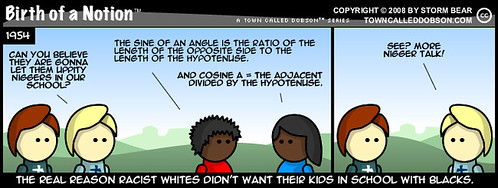 click to enlarge From Wikipedia: Brown v. Board of Education of Topeka, 347 U.S. 483 (1954), was a landmark decision of the United States Supreme Court, which overturned earlier rulings going back to Plessy v. Ferguson in 1896, by declaring that state laws that established separate public schools for black and white students denied black children equal educational opportunities. Handed down on May 17, 1954, the Warren Court's unanimous (9-0) decision stated that "separate educational facilities are inherently unequal." As a result, de jure racial segregation was ruled a violation of the Equal Protection Clause of the Fourteenth Amendment of the United States Constitution. This victory paved the way for integration and the civil rights movement. Much of the ninety years preceding the Brown case, race relations in the U.S. had been dominated by racial segregation. This policy had been endorsed in 1896 by the United States Supreme Court case of Plessy v. Ferguson, which held that as long as the separate facilities for the separate races were "equal," the segregation did not violate the Fourteenth Amendment ("no state shall... deny to any person... the equal protection of the laws.") The plaintiffs in Brown asserted that this system of racial separation, while masquerading as providing separate but relatively equal treatment of both white and black Americans, instead perpetuated inferior accommodations, services, and treatment for black Americans. Racial segregation in education varied widely from the 17 states that required racial segregation to the 16 that prohibited it. Brown was influenced by UNESCO's 1950 Statement, signed by a wide variety of internationally-renowned scholars, titled The Race Question. This declaration denounced previous attempts at scientifically justifying racism as well as morally condemning racism. Another work that the Supreme Court cited was Gunnar Myrdal's An American Dilemma: The Negro Problem and Modern Democracy (1944). Myrdal had been a signatory of the UNESCO declaration. The research performed by the educational psychologists Kenneth B. Clark and Mamie Phipps Clark also influenced the Court's decision. The Clark's "doll test" studies presented substantial arguments to the Supreme Court about how segregation had an impact on black schoolchildren's mental status. In 1951, a class action suit was filed against the Board of Education of the City of Topeka, Kansas in the U.S. District Court for the District of Kansas. The plaintiffs were thirteen Topeka parents on behalf of their twenty children. The suit called for the school district to reverse its policy of racial segregation. Separate elementary schools were operated by the Topeka Board of Education under an 1879 Kansas law, which permitted (but did not require) districts to maintain separate elementary school facilities for black and white students in twelve communities with populations over 15,000. The plaintiffs had been recruited by the leadership of the Topeka NAACP. Notable among the Topeka NAACP leaders were the chairman McKinley Burnett; Charles Scott, one of three serving as legal counsel for the chapter; and Lucinda Todd. The named plaintiff, Oliver L. Brown was a parent, a welder in the shops of the Santa Fe Railroad, an assistant pastor at his local church, and an African American. He was convinced to join the lawsuit by Scott, a childhood friend. Brown's daughter Linda, a third grader, had to walk six blocks to her school bus stop to ride to Monroe Elementary, her segregated black school one mile (1.6 km) away, while Sumner Elementary, a white school, was seven blocks from her house. As directed by the NAACP leadership, the parents each attempted to enroll their children in the closest neighborhood school in the fall of 1951. They were each refused enrollment and directed to the segregated schools. Linda Brown Thompson later recalled the experience in a 2004 PBS documentary:
The Kansas case, "Oliver Brown et al v. The Board of Education of Topeka, Kansas," was named after Oliver Brown as a legal strategy to have a man at the head of the roster. Also, it was felt by lawyers with the National Chapter of the NAACP, that having Mr. Brown at the head of the roster would be better received by the U.S. Supreme Court Justices because Mr.Brown had an intact, complete family, as opposed to someone who was a single parent head of household. The thirteen plaintiffs were: Oliver Brown, Darlene Brown, Lena Carper, Sadie Emmanuel, Marguerite Emerson, Shirley Fleming, Zelma Henderson, Shirley Hodison, Maude Lawton, Alma Lewis, Iona Richardson, and Lucinda Todd. The last surviving plaintiff, Zelma Henderson, died in Topeka, on May 20, 2008, at the age of 88. The District Court ruled in favor of the Board of Education, citing the U.S. Supreme Court precedent set in Plessy v. Ferguson, 163 U.S. 537 (1896), which had upheld a state law requiring "separate but equal" segregated facilities for blacks and whites in railway cars. The three-judge District Court found that segregation in public education has a detrimental effect upon negro children, but denied relief on the ground that the negro and white schools in Topeka were substantially equal with respect to buildings, transportation, curricular, and educational qualifications of teachers. The case of Brown v. Board of Education as heard before the Supreme Court combined five cases: Brown itself, Briggs v. Elliott (filed in South Carolina), Davis v. County School Board of Prince Edward County (filed in Virginia), Gebhart v. Belton (filed in Delaware), and Bolling v. Sharpe (filed in Washington D.C.). All were NAACP-sponsored cases. The Davis case, the only case of the five originating from a student protest, began when sixteen year old Barbara Rose Johns organized and led a 450 student walkout of Moton High School. The Kansas case was unique among the group in that there was no contention of gross inferiority of the segregated schools' physical plant, curriculum, or staff. The district court found substantial equality as to all such factors. The Delaware case was unique in that the District Court judge in Gebhart ordered that the black students be admitted to the white high school due to the substantial harm of segregation and the differences that made the schools separate but not equal. The NAACP's chief counsel, Thurgood Marshall — who was later appointed to the U.S. Supreme Court in 1967 — argued the case before the Supreme Court for the plaintiffs. Assistant attorney general Paul Wilson — later distinguished emeritus professor of law at the University of Kansas — conducted the state's ambivalent defense in his first appellate trial. Not everyone accepted the Brown v. Board of Education decision. In Virginia, Senator Harry F. Byrd, Sr. organized the Massive Resistance movement that included the closing of schools rather than desegregating them. See, for example, The Southern Manifesto. For more implications of the Brown decision, see Desegregation. In 1957, Arkansas Governor Orval Faubus called out his state's National Guard to block black students' entry to Little Rock High School. President Dwight Eisenhower responded by deploying elements of the 101st Airborne Division from Fort Campbell, Kentucky to Arkansas and by federalizing Faubus' National Guard. Also in 1957, Florida's response was mixed. Its legislature passed an Interposition Resolution denouncing the decision and declaring it null and void. But Florida Governor Thomas LeRoy Collins refused to sign it arguing that the state must follow the Supreme Court's ruling. Tourism and Florida's popular image probably played a role in its muted response. In 1963, Alabama Gov. George Wallace personally blocked the door to Foster Auditorium at the University of Alabama to prevent the enrollment of two black students. This became the infamous "Stand at the Schoolhouse Door," where Wallace personally backed his "segregation now, segregation tomorrow, segregation forever" policy that he had stated in his 1963 inaugural address. He moved aside only when confronted by federal marshals and Deputy Attorney General Nicholas Katzenbach. Plessy v. Ferguson, the landmark United States Supreme Court decision, upholding the constitutionality of racial segregation, under the doctrine of "separate but equal" were, in part, tied to the scientific racism of the era, however the popular support for the decision was more likely a result of the racist beliefs held by many whites at the time. In deciding Brown v. Board of Education, the Supreme Court rejected the ideas of scientific racists about the need for segregation, especially in schools. The Court buttressed its holding by citing social science research about the harms to black children caused by segregated schools. Both scholarly and popular ideas of scientific racism played an important role in the attack and backlash that followed the Brown decision. The Mankind Quarterly is a journal that has published scientific racism. It was founded in 1960, in part in response to the 1954 United States Supreme Court decision Brown v. Board of Education that ordered the desegregation of U.S. schools. Many of the publication's contributors, publishers, and Board of Directors espouse academic hereditarianism. The publication is widely criticized for its extremist politics, antisemitic bent and its support for scientific racism. In 1955, the Supreme Court considered arguments by the schools requesting relief concerning the task of desegregation. In their decision which became known as "Brown II" the court delegated the task of carrying out school desegregation to district courts with orders that desegregation occur "with all deliberate speed," a phrase traceable to Francis Thompson's poem, The Hound of Heaven. Supporters of the earlier decision were displeased with this decision. The language “all deliberate speed” was seen by critics as too ambiguous to ensure reasonable haste for compliance with the court's instruction. Many Southern states and school districts interpreted "Brown II" as legal justification for resisting, delaying, and avoiding significant integration for years — and in some cases for a decade or more — using such tactics as closing down school systems, using state money to finance segregated "private" schools, and "token" integration where a few carefully selected black children were admitted to former white-only schools but the vast majority remained in underfunded, unequal black schools. For example, based on "Brown II," the U.S. District Court ruled that Prince Edward County, Virginia did not have to desegregate immediately. When another court case in 1959 ruled that the county's schools finally had to desegregate, the county board of supervisors stopped appropriating money for public schools which remained closed for five years, from 1959 to 1964. White students in the county were given assistance to attend white-only "private academies" that were taught by teachers formerly employed by the public school system, while black students had no education at all unless they moved out of the county. In 1978, Topeka attorneys Richard Jones, Joseph Johnson and Charles Scott Jr. (son of the original Brown team member), with assistance from the American Civil Liberties Union, persuaded Linda Brown Smith — who now had her own children in Topeka schools — to be a plaintiff in reopening Brown. They were concerned that the Topeka Public Schools' policy of "open enrollment" had led to and would lead to further segregation. They also believed that with a choice of open enrollment, white parents would shift their children to "preferred" schools that would create both predominantly African American and predominantly European American schools within the district. The district court reopened the Brown case after a 25-year hiatus, but denied the plaintiffs' request finding the schools "unitary". In 1989, a three-judge panel of the 10th Circuit on 2-1 vote found that the vestiges of segregation remained with respect to student and staff assignment. In 1993, the Supreme Court denied the appellant School District's request for certiorari and returned the case to District Court Judge Richard Rodgers for implementation of the Tenth Circuit's mandate. After a 1994 plan was approved and a bond issue passed, additional elementary magnet schools were opened and district attendance plans redrawn, which resulted in the Topeka schools meeting court standards of racial balance by 1998. Unified status was eventually granted to Topeka Unified School District #501 on July 27, 1999. One of the new magnet schools is named after the Scott family attorneys for their role in the Brown case and civil rights. Birth Of A Notion Disclaimer & Sources BIRTH OF A NOTION WALLPAPER is now available for your computer. Click here. |
Monday, August 4, 2008
McCain: The Return of Folksy Racism
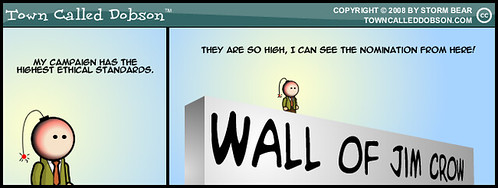 click to enlarge This Presidential (I use the term loosely) race has been circling the drain for some time. McCain’s insistence on using racially charged themes in advertising, speeches and actions is sickening. Bush has made the office of the President and festering boil on the nation and John McCain is taking the Bush Legacy and making it worse if you can imagine that. I am unsure anyone wants to live in McCain’s America unless they are the worst of human beings. And if that is the crowd you are collecting under your shadow, what does that day about you? |
Friday, May 16, 2008
Hahaha! Assassinations Are Funny!
Appearing at The Jaundiced Eye, the Independent Bloggers' Alliance, and My Left Wing. Can someone explain to me what the fuck Mike Huckabee thought he was doing here? This is a joke? Fantasizing about someone aiming a gun at possibly the first black president of the United States? And note that he's in Louisville, Kentucky; deep in the heart of Hillary's (ahem) "key demographic." |
Black History: The Ku Klux Klan
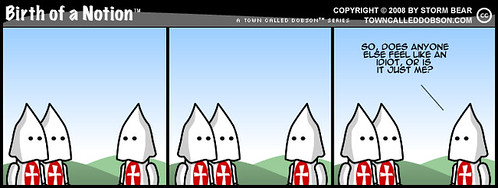 click to enlarge The first Klan was founded in 1866 by veterans of the Confederate Army. Its purpose was to restore white supremacy in the aftermath of the American Civil War. The Klan resisted Reconstruction by intimidating "carpetbaggers", "scalawags" and freedmen. The KKK quickly adopted violent methods. The increase in murders finally resulted in a backlash among Southern elites who viewed the Klan's excesses as an excuse for federal troops to continue occupation. The organization declined from 1868 to 1870 and was destroyed by President Ulysses S. Grant's prosecution and enforcement under the Civil Rights Act of 1871. In 1915, the second Klan was founded. It grew rapidly in another period of postwar social tensions. After WWI, many Americans coped with booming growth rates in major cities, where numerous waves of immigrants from southern and eastern Europe and the Great Migration of Southern blacks and whites were being absorbed. After WWI, labor tensions rose as veterans tried to reenter the work force. In reaction to these new groups of immigrants and migrants, the second KKK preached racism, anti-Catholicism, anti-Communism, nativism, and anti-Semitism. Some local groups took part in lynchings, attacks on private houses and public property, and other violent activities. Members used ceremonial cross burning to intimidate victims and demonstrate its power. Murders and violence by the Klan were most numerous in the South, which had a tradition of lawlessness. The film The Birth of a Nation and the sensationalized newspaper coverage of the trial, conviction and lynching of Leo Frank of Georgia sparked the Klan's revival. The second Klan was a formal fraternal organization, with a national and state structure. At its peak in the mid-1920s, the organization included about 15% of the nation's eligible population, approximately 4–5 million men. The Klan's popularity fell rapidly during the Great Depression, and membership fell further during World War II. The name Ku Klux Klan has since been used by many independent groups opposing the Civil Rights Movement and desegregation, especially in the 1950s and 1960s. During this period, they often acted with impunity by alliances with Southern police departments, as during the reign of Bull Connor in Birmingham, Alabama; or governor's offices, as with George Wallace of Alabama. Several members of KKK-affiliated groups were convicted of manslaughter and murder in the deaths of civil rights workers and children in the bombing of the 16th Street Baptist Church in Alabama, the assassination of NAACP organizer Medgar Evers, and the murders of three civil rights workers in Mississippi. Today, researchers estimate there may be more than 150 Klan chapters with 5,000-8,000 members nationwide. The U.S. government classifies them as hate groups, with operations in separated small local units. The modern KKK has been repudiated by all mainstream media, political and religious leaders. As W.E.B. DuBois noted, "It is always difficult to stop war, and doubly difficult to stop civil war...In the case of civil war, where the contending parties must rest face to face after peace, there can be no quick and perfect peace." As reported by Mississippi Governor Sharkey in 1866, disorder, lack of control and lawlessness were widespread; in some states armed bands of Confederate soldiers roamed at will. Southerners seemed to take out on blacks all their wrath at the Federal government. They casually attacked and killed blacks whose bodies were left on the roads. The original Ku Klux Klan was created in the aftermath of the American Civil War by six educated, middle-class Confederate veterans on December 24, 1865. from Pulaski, Tennessee. They made up the name by combining the Greek "kyklos" (κυκλος,circle) with "clan" It was one among a number of secret, oath-bound organizations, including the Southern Cross in New Orleans (1865), and the Knights of the White Camellia. In an 1867 meeting in Nashville, Tennessee, Klan members gathered to try to create a hierarchical organization with local chapters reporting eventually up to national headquarters. As most of them were veterans, they were used to such organization. Former Confederate Brigadier General George Gordon put the proposals together in what was called the "Prescript." The Prescript suggested elements of white supremacy belief. For instance, an applicant should be asked if he was in favor of "a white man's government", "the reenfranchisement and emancipation of the white men of the South, and the restitution of the Southern people to all their rights." Despite Gordon's work, local Klan units never accepted the Prescript and continued to operate autonomously. There were never hierarchical levels or state headquarters. Gordon supposedly told former slave trader and Confederate General Nathan Bedford Forrest in Memphis, Tennessee, about the Klan. Forrest allegedly responded, "That's a good thing; that's a damn good thing. We can use that to keep the niggers in their place." A few weeks later, Forrest was selected as Imperial Wizard, the Klan's national leader, though he always denied leadership. In effect, the Klan defended the interest of the planter class and Democratic Party by working to curb the education, economic advancement, voting rights, and right to keep and bear arms of blacks. The Ku Klux Klan soon spread into nearly every southern state, launching a "reign of terror" against Republican leaders both black and white. Those political leaders assassinated during the campaign included Arkansas Congressman James M. Hinds, three members of the South Carolina legislature, and several men who served in constitutional conventions." In an 1868 newspaper interview, Forrest stated the Klan's primary opposition was to the Loyal Leagues, Republican state governments, people like Tennessee governor Brownlow and other carpetbaggers and scalawags. He claimed that many southerners believed blacks were voting for the Republican Party because they were being hoodwinked by the Loyal Leagues. One Alabama newspaper editor declared "The League is nothing more than a nigger Ku Klux Klan." At the local level, however, old feuds and grudges were the cause of numerous attacks, and Klan members worked for their own dominance in the disrupted postwar society. Klan members adopted masks and robes that hid their identities and added to the drama of their night rides, their chosen time for attacks. Many of them operated in small towns and rural areas where people otherwise knew each other's faces. "The kind of thing that men are afraid or ashamed to do openly, and by day, they accomplish secretly, masked, and at night." With this method both the high and the low could be attacked. Some blacks believed Ku Klux Klan night riders were the ghosts of dead Confederates. The Klan raided black members of the Loyal Leagues and intimidated southern Republicans and Freedmen's Bureau workers. Agents of the Freedmen's Bureau reported weekly assaults and murders of blacks. "Armed guerilla warfare killed thousands of Negroes; political riots were staged; their causes or occasions were always obscure, their results always certain: ten to one hundred times as many Negroes were killed as whites." Masked men shot into houses and burned them, sometimes with the occupants still inside. They drove successful black farmers off their land. General Canby reported that in North and South Carolina, in 18 months ending in June 1867, there were 197 murders and 548 cases of aggravated assault. Klan violence worked to suppress black voting. As examples, over 2,000 persons were killed, wounded and otherwise injured in Louisiana within a few weeks prior to the Presidential election of November 1868. Although St. Landry Parish had a registered Republican majority of 1,071, after the murders, no Republicans voted in the fall elections. White Democrats cast the full vote of the parish for Grant's opponent. The KKK killed and wounded more than 200 black Republicans, hunting and chasing them through the woods. Thirteen captives were taken from jail and shot; a half-buried pile of 25 bodies was found in the woods. The KKK made people vote Democratic and gave them certificates of the fact. In the April 1868 Georgia gubernatorial election, Columbia County cast 1,222 votes for Republican Rufus Bullock. By the November presidential election, however, Klan intimidation led to suppression of the Republican vote and only one person voted for Ulysses S. Grant. Klansmen killed more than 150 African Americans in a county in Florida, and hundreds more in other counties. Freedmen's Bureau records provided a detailed recounting of beatings and murders of freedmen and their white allies by Klansmen. By 1868, two years after the Klan's creation, its activity was beginning to decrease. Members were hiding behind Klan masks and robes as a way to avoid prosecution for free-lance violence. Many influential southern Democrats feared that Klan lawlessness provided an excuse for the federal government to retain its power over the South, and they began to turn against it. There were outlandish claims made, such as Georgian B.H. Hill stating "that some of these outrages were actually perpetrated by the political friends of the parties slain." Although Forrest boasted the Klan was a nationwide organization of 550,000 men and he could muster 40,000 Klansmen with five days' notice, as a secret or "invisible" group, it had no membership rosters, no chapters, no local officers, making it difficult for observers to judge its membership. It had created a sensation by the dramatic nature of its masked forays and many murders. One Klan official complained his, "so-called 'Chief'-ship was purely nominal, I having not the least authority over the reckless young country boys who were most active in 'night-riding,' whipping, etc., all of which was outside of the intent and constitution of the Klan..." A federal grand jury in 1869 determined the Klan was a "terrorist organization." It issued hundreds of indictments for crimes of violence and terrorism. Klan members were prosecuted, and many fled jurisdiction, particularly in South Carolina. Many people not formally inducted into the Klan had used the Klan's uniform for anonymity, to hide their identities when carrying out acts of violence. Forrest ordered the Klan to disband in 1869, stating it was "being perverted from its original honorable and patriotic purposes, becoming injurious instead of subservient to the public peace." Historian Stanley Horn writes "generally speaking, the Klan's end was more in the form of spotty, slow, and gradual disintegration than a formal and decisive disbandment." A reporter in Georgia wrote in January 1870, "A true statement of the case is not that the Ku Klux are an organized band of licensed criminals, but that men who commit crimes call themselves Ku Klux." While people used the Klan as a mask for nonpolitical crimes, state and local governments seldom acted against them. African Americans were kept off juries. In lynching cases, all-white juries almost never indicted Klan members. When there was a rare indictment, juries were unlikely to vote for conviction. In part, jury members feared reprisals from local Klansmen. Others may have agreed with lynching as a way of keeping dominance over black men. In many states, officials were reluctant to use black militia against the Klan from fear that race tensions would be raised. When Republican Governor of North Carolina William Woods Holden called out the militia against the Klan in 1870, it added to his unpopularity. Combined with violence and fraud at the polls, in the election, the Republicans lost their majority in the state legislature. Disaffection with Holden's actions led to white Democratic legislators' impeaching Holden and removing him from office, but their reasons were numerous. Union Army veterans in mountainous Blount County, Alabama, organized 'the anti-Ku Klux.' They put an end to violence by threatening Klansmen with reprisals unless they stopped whipping Unionists and burning black churches and schools. Armed blacks formed their own defense in Bennettsville, South Carolina and patrolled the streets to protect their homes. National sentiment gathered to crack down on the Klan, even though some Democrats at the national level questioned whether the Klan existed or was a creation of nervous Southern Republican governors. Many southern states began to pass anti-Klan legislation. In January 1871, Pennsylvania Republican Senator John Scott convened a Congressional committee which took testimony from 52 witnesses about Klan atrocities. They accumulated 12 volumes of horrifying testimony. In February, former Union General and Congressman Benjamin Franklin Butler of Massachusetts introduced the Ku Klux Klan Act. This added to the enmity southern white Democrats bore toward him. While the bill was being considered, further violence in the South swung support for its passage. The Governor of South Carolina appealed for federal troops to assist his keeping control. A riot and massacre in a Meridian, Mississippi, courthouse were reported, from which a black state representative escaped only by taking to the woods. n 1871, President Ulysses S. Grant signed Butler's legislation. The Ku Klux Klan Act was used by the Federal government together with the 1870 Force Act to enforce the civil rights provisions for individuals under the constitution. Under the Klan Act, Federal troops were used for enforcement, and Klansmen were prosecuted in Federal court. More African Americans served on juries in Federal court than were selected for local or state juries, so had a chance to participate in the process. In the crackdown, hundreds of Klan members were fined or imprisoned. In South Carolina, habeas corpus was suspended in nine counties. The Klan was destroyed in South Carolina and decimated throughout the rest of the South, where it had already been in decline. Attorney General Amos Tappan Ackerman led the prosecutions. "By 1872, the Klan as an organization was broken." In some areas, other local paramilitary organizations such as the White League, Red Shirts, saber clubs, and rifle clubs continued intimidation and murder of black voters. Although destroyed, the Klan achieved many of its goals, such as suppressing suffrage for Southern blacks and driving a wedge between poor whites and blacks. Despite suppression of the Klan, violence continued against African Americans as whites struggled for power. On Easter Sunday 1873, black citizens fought a mixed political and racial battle against white militia in Colfax, Louisiana. The ostensible cause was an election contested at both the state and local levels. Each man elected sheriff claimed the local office. When black Republicans gathered at the courthouse, white militia collected to force them to leave. Estimates of African Americans killed overnight and into the next day were 105 to 280. Some bodies were hidden in the woods or thrown in the river; others buried before state and Federal troops arrived. African-American legislator John G. Lewis remarked, "They attempted (armed self-defense) in Colfax. The result was that on Easter Sunday of 1873, when the sun went down that night, it went down on the corpses of two hundred and eighty negroes." The Colfax Massacre had the highest fatalities of any incident of racial violence during Reconstruction. Shortly after, in United States v. Cruikshank (1875), the Supreme Court ruled that the few convictions achieved after the Colfax Massacre were faulty. It ruled that the Force Act of 1870 did not give the Federal government power to regulate private actions, but only those by state governments. The result was that as the century went on, African Americans were at the mercy of hostile state governments to intervene against private violence and paramilitary groups. In 1882, long after the Klan was destroyed, the Supreme Court ruled in United States v. Harris that the Klan Act was partially unconstitutional. It ruled that Congress's power under the Fourteenth Amendment did not extend to regulate against private conspiracies. As 20th century Supreme Court rulings extended Federal enforcement of citizens' civil rights, the Force Act and the Klan Act were used by 20th c. Federal prosecutors as the basis for investigation and indictments in the 1964 murders of Chaney, Goodman, and Schwerner; and the 1965 murder of Viola Liuzzo. They were also the basis of prosecution in 1991 in Bray v. Alexandria Women's Health Clinic. The nadir of American race relations is often placed from the end of reconstruction to the 1910s, especially in the South. Once white Democrats regained political power in state legislatures in the 1870s, they passed bills directed at restricting voter registration by blacks and poor whites. Continued low cotton prices, agricultural depression and labor shortages in the South contributed to social tensions. According to Tuskegee Institute, the 1890s was also the peak decade for lynchings, with most of them directed against African Americans in the South. The lynchings were a byproduct of political tensions as white Democrats tried to strip blacks from voter rolls and suppress voting. Some of the violence was directed at trying to break up interracial coalitions that came to power in state legislatures in 1894, with alliances of Populist and Republican parties. In 1896 the Democrats used fraud, violence and intimidation to suppress voting by poor classes, and regained power. From 1890 to 1908, ten of eleven southern states ratified new constitutions or amendments that completed disfranchisement of most African Americans and many poor whites. The constitutions had provisions making voter registration more complicated: such as poll taxes, residency requirements, recordkeeping and literacy tests, which were often subjectively applied. In addition, in voting sometimes multiple ballot boxes were used. The result was that blacks and poor whites in most southern states were deprived of suffrage, representation at any level of government, local elected offices, and the right to serve on juries (usually restricted to voters). In most of the South, sweeping disfranchisement and white one-party government lasted until African Americans' leadership and activism in the Civil Rights Movement gained passage of Federal civil rights legislation in 1964 and 1965. Beginning in 1910 and going through 1940, tens of thousands of African Americans decided to leave the South and its violence and segregation, in a movement known as the Great Migration. They went to northern and midwestern cities for jobs, better education for their children, a chance to vote, and the hopes of living with less violence. Northern industry recruited black workers because of a shortage of labor for expanding industries: for instance, the Pennsylvania Railroad hired 12,000 men, all but 2,000 of them from Florida and Georgia SPECIAL REQUEST FOR TCD FANS: The San Francisco Chronicle is pondering the addition of new cartoons for their paper - a process that seems to be initiated by Darren Bell, creator of Candorville (one of my daily reads - highly recommended). You can read the Chronicle article here and please add your thoughts to the comments if you wish. If anything, put in a good word for Darren and Candorville. I am submitting Town Called Dobson to the paper for their consideration. They seem to have given great weight to receiving 200 messages considering Candorville. I am asking TCD fans to try to surpass that amount. (I get more than that many hate mails a day, surely fans can do better?) This is not a race between Darren and I, it is a hope that more progressive strips can be represented in the printed press of America. So if you read the San Francisco Chronicle or live in the Bay Area (Google Analytics tell me there are a lot of you), please send your kind comments (or naked, straining outrage) to David Wiegand at his published addresses below. If you are a subscriber, cut out your mailing label and staple it to a TCD strip and include it in your letter. candorcomment@sfchronicle.com or David Wiegand Executive Datebook Editor The San Francisco Chronicle 901 Mission St. San Francisco, CA 94103 Birth Of A Notion Disclaimer BIRTH OF A NOTION WALLPAPER is now available for your computer. Click here. |
Monday, March 24, 2008
Black History: The Slave Coast
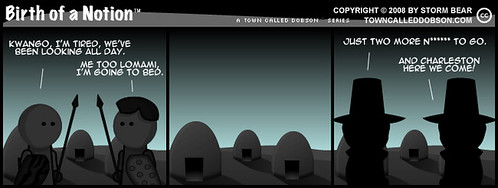 click to enlarge The first Europeans to use African slaves in the New World were the Spaniards who sought auxiliaries for their conquest expeditions and laborers on islands such as Cuba and Hispaniola, where the alarming decline in the native population had spurred the first royal laws protecting the native population. The first African slaves arrived in Hispaniola in 1501. In 1452, Pope Nicholas V issued the papal bull Dum Diversas, granting Afonso V of Portugal the right to reduce any "Saracens, pagans and any other unbelievers" to hereditary slavery. This approval of slavery was reaffirmed and extended in his Romanus Pontifex bull of 1455. These papal bulls came to serve as a justification for the subsequent era of slave trade and European colonialism. The followers of the church of England and Protestants did not use the papal bull as a justification. Increasing penetration into the Americas by the Portuguese created more demand for labor in Brazil--primarily for farming and mining. Slave-based economies quickly spread to the Caribbean and the southern portion of what is today the United States. These areas all developed an insatiable demand for slaves. As European nations grew more powerful, especially Portugal, Spain, France and England, they began vying for control of the African slave trade, with little effect on the local African and Arab trading. Great Britain's existing colonies in the Lesser Antilles and their effective naval control of the Mid Atlantic forced other countries to abandon their enterprises due to inefficiency in cost. The English crown provided a charter giving the Royal African Company monopoly over the African slave routes until 1712. The Atlantic slave trade peaked in the late 18th century, when the largest number of slaves were captured on raiding expeditions into the interior of West Africa. These expeditions were typically carried out by African kingdoms, such as the Oyo empire (Yoruba), Kong Empire, Kingdom of Benin, Kingdom of Fouta Djallon, Kingdom of Fouta Tooro, Kingdom of Koya, Kingdom of Khasso, Kingdom of Kaabu, Fante Confederacy, Ashanti Confederacy, and the kingdom of Dahomey. Europeans rarely entered the interior of Africa, due to fear of disease and moreover fierce African resistance. Before the arrival of the Portuguese, slavery had already existed in Kingdom of Kongo. Despite its establishment within his kingdom, Afonso I of Kongo believed that the slave trade should be subject to Kongo law. When he suspected the Portuguese of receiving illegally enslaved persons to sell, he wrote letters to the King João III of Portugal in 1526 imploring him to put a stop to the practice. The kings of Dahomey sold their war captives into transatlantic slavery, who otherwise would have been killed in a ceremony known as the Annual Customs. As one of West Africa's principal slave states, Dahomey became extremely unpopular with neighboring peoples. Like the Bambara Empire to the east, the Khasso kingdoms depended heavily on the slave trade for their economy. A family's status was indicated by the number of slaves it owned, leading to wars for the sole purpose of taking more captives. This trade led the Khasso into increasing contact with the European settlements of Africa's west coast, particularly the French. Benin grew increasingly rich during the 16th and 17th centuries on the slave trade with Europe; slaves from enemy states of the interior were sold, and carried to the Americas in Dutch and Portuguese ships. The Bight of Benin's shore soon came to be known as the "Slave Coast". Disclaimer:
|
Friday, March 21, 2008
Black History: Raw Human Stock
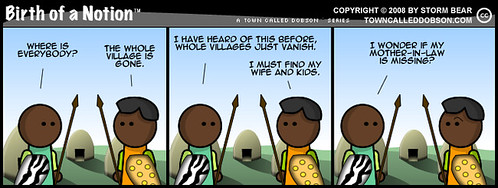 click to enlarge While some slaves shipped to Europe and America had previously been African slaves, many enslaved had been innocent bystanders. It was not uncommon for the Europeans to hide and wait for an African to come along, and then kidnap him. The retrieval of slaves was also obtained through Africans convicted of a crime. It was also likely for Africans of a tribe to be captured by an enemy tribe as a prisoner of war and then exchanged for goods. This lasted from the 15th to the 19th century, devastating the lives of at least ten to twenty million Africans. All forced into foreign enslavement, exported in exchange for imported goods. This is known as the slave trade. |
Thursday, March 20, 2008
Ancient Goat Casinos of Thebes
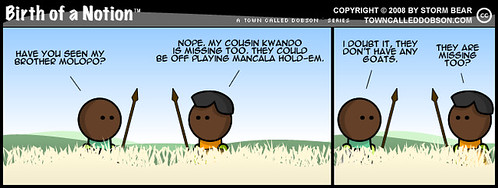 click to enlarge But before the slave trade, thousands of years before the New World was discovered there was a game called Mancala (also called Oware, Bao and many other names). It is an abstract strategy game that originated in Africa and predates Chess and its predecessors. Game boards have been found carved in stone all up and down the Egyptian temples that lined the Nile, including the Temple of Karnack. It is a wholly mathematical game - its more complex versions have as much scope as Chess, despite its primitive origins. From Oware.org: The diffusion of pit and pebble games throughout the world from Africa can be explained by the migration of African people to various parts of the world, both voluntary and forcefully as in the case of the Trans-Atlantic and Eastern slave trades from Africa. This is confirmed by the use of the same rules in parts of West Africa and the Caribbean. It is played all over the world from the Far East, Middle East, Asia, Africa, to the Caribbean. There is even evidence to prove that it was and may be still played in its traditional form in some southern states of America and in some of the former Soviet states. |
Wednesday, March 19, 2008
This cartoon is not funny.
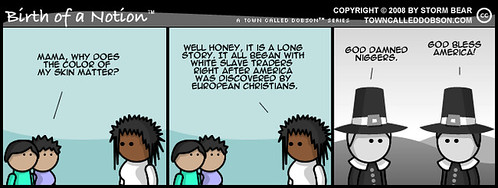 click to enlarge Some of the talking heads on MSM and on local talk radio can't figure out why Obama did not called for the beheading of Jeremiah Wright. Because if you take the 5 quotes the media has been playing over and over and look at the rest of these sermons, they are fiery oratories on the Black experience in America which many Americans won't understand because they have never been called "nigger." When I went to school, we were never taught Black History. We never learned about the Black leaders, the long, agonizing history that brought most Blacks to America. Those atrocities were glossed over in favor of mindlessly boring topics like the X Y Z Affair. This series of cartoons will review Black history as told from a Black mother to an interracial child. This series will be ugly, course, horrific and truthful. I will mostly abandon the commentary for an article on Black history. This series is not about Obama or Hillary. I want to you to try to imagine how Black families tell their children of the atrocities their ancestors, all of them, suffered because of the color of their skin. Try to imagine how Black families counsel their children when someone calls them "nigger" for the first time. Can you imagine the bone crushing emotion that must well up? Can you imagine the agony, frustration and anger? Can you imagine being the Black preacher who tries to pant a picture of a just God every Sunday? Especially in a country that claims where the notion of racism is a thing of the past, the job is difficult. These strips may at times be entertaining and sometimes they may not. I don't want you to laugh so hard you cry, I want you to cry so hard you do something about it. |
Thursday, March 13, 2008
Racist Mississippi
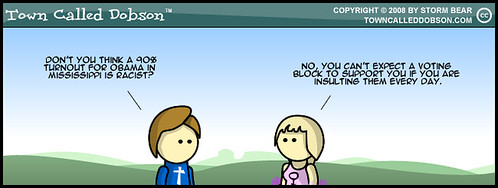 click to enlarge Over the last 48 hours, I have seen on television and on the blogosphere the notion that Blacks are racist because they are turning out in droves (one drove apparently equals 90% of the demographic) for Barack Obama. I am admittedly confounded by this. The explanation seems so simple, so obvious that the question does not even need to be addressed. Apparently it does. The issue of why Blacks vote in droves for Obama may have roots in Black pride, but there was great affection for the Clintons in the Black community - note the use of the past tense. That was before Hillary's atrocious behavior in Selma last year. The use of a mocking fake slave accent during the recital of Cleveland's poetry was horrific and it was the final insult as Hillary crashed the festivities that Obama was invited to headline. Hillary wasn't. Then after Obama and Edwards mopped the floor with Hillary in Iowa (Edwards being the token white guy), the overt race-baiting began. The tears of being beaten by a Black man helped her win New Hampshire. "Weep for me, they are so unfair." Fairy tales and Farrakhan - that became the Clintonian strategy. The last straw came with the 3am commercial and the rhetoric claiming Obama is not fit to be Commander in Chief. The Clintons have pissed all over Black America to the point that they are no longer seen as being affectionate to the cause of Black America. This was before Geraldine Ferraro opened her mouth. Now that the cat is out of the bag, there is no redeeming the Clinton campaign in the eyes of the Black community. To them, there is only one viable candidate left and it should not be rocket science to figure out why Blacks vote for Obama. It is his policies, his vision that garners him support - and his ability not to insult Blacks at every turn. Barack Obama is a candidate who does bring all races together. That is the true dream of Dr. King. Hillary Clinton is the nightmare. |
Wednesday, March 12, 2008
There Will Be Cross Burnings
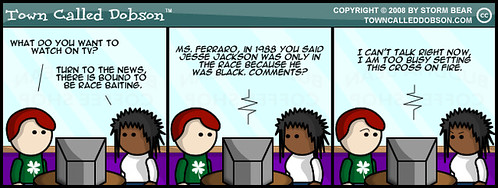 click to enlarge On Politico, there is a short quote from Ferraro that originally appeared in the Washington Post on April 15, 1988. Placid of demeanor but pointed in his rhetoric, Jackson struck out repeatedly today against those who suggest his race has been an asset in the campaign. President Reagan suggested Tuesday that people don't ask Jackson tough questions because of his race. And former representative Geraldine A. Ferraro (D-N.Y.) said Wednesday that because of his "radical" views, "if Jesse Jackson were not black, he wouldn't be in the race." No further commentary required. |
Wednesday, February 13, 2008
Feminists 1, Biblethumpers 0
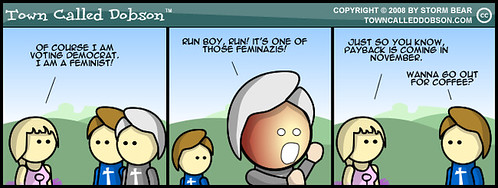 click to enlarge For example let's look at the Ku Klux Klan. The KKK used to be a huge influence, especially in the American South. They were terrorists and those that are still members of the Klan should be regarded as terrorists. They should be put on the no-fly list and treated the same as Al Qaeda. Eventually, over several generations, America tossed out the idea of "blacks being inferior" and we have moved toward a more colorless society. Before you send me hate mail, let me say, racism is alive and well in America and we still have a long way to go. A very long way. When I was born in the 60's, Blacks in the South had to jump through unimaginable hoops just to vote. Now, the woman that handled my last voter registration issue at the local Board of Elections was Black. In less than 40 years, that is a HUGE change. Less than 50 years ago, a Black man marrying a White woman could lead to a lynching. Now, hardly anyone cares. I am a White guy who has been married to a Black woman for 15 years and never has anyone come up to me and said something stupid. We are just another American couple - not a mixed race couple, an American couple. Even when we travel to the rural parts of North Carolina, where Rebel Flags grace damn near every front yard, no one cause a ruckus, no one give us the disapproving eye. Nothing. Clearly, we are not living in 1960. Clearly Dr. King moved mountains. I think the internet helps. The web is a barrage of free speech - an assault of ideas ranging from sublime to spectacular. From recipes to lifestyles, you are constantly having your ideas challenged. Your way of thinking reevaluated. It as neurological Darwinism on fast forward. It happens one person at a time. Before I moved to the real town of Dobson, NC, I was well on my way to challenging the ideas of my evangelical family. The first thing on the list was religion, or at least the laundry list of crazy ideas I was required to subscribe to. And religion was the first thing to go. I went to the Synagogue, I went to the Mosque, I went to everything I could find. (I never could find a snake-handling church - that would have rocked!) I eventually dumped Christianity and went home. Same thing we race. I started dating out of my race in High School (more like mowed through according to my friends at the time). Then my political views were challenged. Tink Von Wagnersteinstadtdorffmacher is the new character in the strip - actually not new, I drew her years ago as she was one of the original characters but it is her first appearance. Her storyline is starting. Biblethumper Jr. has increasingly been questioning his father for some time. And now he has met Tink and Tink will change him more than he ever expected. The real life Tink is a girl I went to High School with. I loved spending time with her family. The stuff her brother and I got into was right out of Ferris Bueller. There was this one time we met this redneck with a donkey... oh never mind... Tink didn't read Teen Beat or magazines focused on the young female demographic, she subscribed to US News and World Report. After her brother and I would finish up a night of harassing rednecks on the back roads of Surry County, the Von Wagnersteinstadtdorffmacher family and I would drive to Hardee's at midnight for a round of biscuits and foreign policy chat. Where others challenged me on racism, they challenged me on politics. And I changed. Yesterday White males flocked to Barack Obama to vote for him in the Potomac Primaries. White guys voted for a Black man to pull this nation to safety. Change has been underway since Dr. King told us of his dream. Barack isn't campaigning on bringing change, he is change manifest. Obama is where he is at today because society changed, one person at a time. |